

AIEngineering2000 @AIEngine2000
Joined December 2025-
Tweets396
-
Followers3
-
Following201
-
Likes4

This is massive, world changing AI news AI achieved superhuman performance in theoretical physics. GPT-6 Astra autonomously solved 49 of 50 unpublished theoretical physics research problems, 98% accuracy at under $3 per problem. $3 per problem, think about it... Crazy part? Researchers initially marked several answers wrong, only to discover that the AI had caught mistakes in calculations by world class physicists. why this is imo way more important and insane news than AI games, pics, recent software disruption? Advancing theoretical physics may give us technologies like: Practical fusion power, antimatter propulsion, relativistic spacecraft, interstellar travel, artificial gravity, vacuum engineering, micro black holes, wormholes, warp drives, solving dark matter and dark energy, theory of everything + 1000s more. we're berely scratching the surface, and super physics AI can easily accelerate our progress 1000s fold, so we can see all this in our lifetimes. just like in math , ~1000 big (unsolved by decads) math problems solved by OpenAI and Google, 50-100 years worth of progress in one week. Now we're moving this disruption and speed to theoretical physics. This will give us Star Trek (and more advanced) tech by 2030s.


I BUILT AN AUTONOMOUS CLOUD MESH POWERED BY CLAUDE What started as a cloud orchestration concept is now a full terminal for coordinating autonomous agents, distributed compute, code synthesis, and deployment across multiple regions → 6 specialized agents handling orchestration, code generation, sandboxing, self-healing, routing, and security checks → 1,428 simulated microVMs managed through a unified control center → 6 global regions connected through a real-time cloud mesh → Automated code pipeline with AST verification, isolated execution, and build monitoring → Self-healing infrastructure designed to detect degraded nodes and recover automatically → Live telemetry for latency, context throughput, cache utilization, and system health The terminal brings the entire lifecycle into one place, from provisioning isolated environments and generating code to validating changes and coordinating guarded rollouts No scattered dashboards. No disconnected workflows. Just one command center built around autonomous infrastructure The goal is simple: let AI coordinate the infrastructure, while the system keeps every stage visible

It is becoming f*cking dangerous: I don't understand why everyone still isn't doing this, thanks to this I reached an income of $12,000 as early as 3 months ago Andrej Karpathy, co-founder of OpenAI, shared a straightforward concept that blew up with over 23 million views: stop relying on AI strictly for coding and start using it to construct your own personal knowledge engine Point Claude Code to a folder, toss in raw materials (whether it's an article, a video transcript, or a PDF) and Claude processes everything, links relevant topics together, and organizes it into a self-updating wiki of your personal knowledge. It acts like compound interest: the more information you add, the more capable it becomes Here is the exact breakdown: Set up Obsidian, create a fresh vault, and open it using Claude Code Supply Karpathy's wiki layout prompt and instruct Claude to build the architecture Claude automatically sets up three components: a raw directory for source files, a wiki directory for processed pages, and a CLAUDE.md control file to run the system Dump any document into the raw folder and run "ingest this" Query your entire knowledge repository at any time, indefinitely It takes just five minutes to configure, eliminating the need to ever start a conversation with a completely blank context window again Check the link below for the complete step-by-step walkthrough on setting up Claude with Obsidian Bookmark this post for later
chatgpt as a f**king full stack operator... most people use AI to get answers, the real unlock is turning it into a workflow that can research, plan, build, verify, and ship without losing track of the actual goal halfway through this prompt gives ChatGPT a structured way to handle complex tasks, choose the right tools, check its own output, and turn messy requests into something you can actually use instead of another wall of text save this one for your next big task ↓


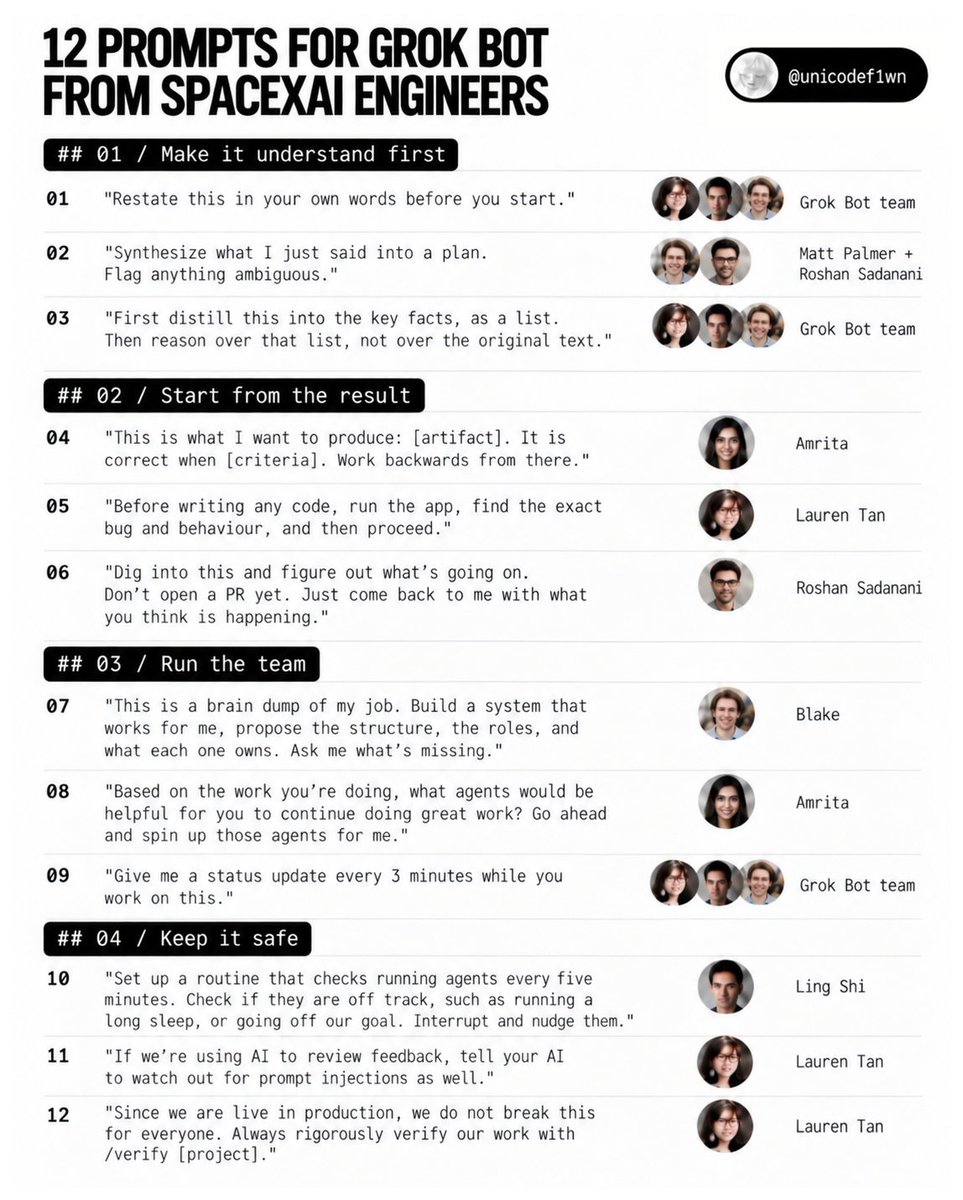
holy f*ck, Elon's SpaceXAI team (Lauren Tan, Roshan Sadanani + 4 more) showed the prompts they run Grok Bot on 12 prompts from 3 days of live builds and workshops, with who used each one next to it how to use the image: 1. save it 2. long messy task: paste #1 and read what the bot says back 3. production bug: paste #6, no PR until it reports back 4. building a team: record a 10-15 minute voice memo, paste #7 5. agents running on their own: paste #10 and #11 save this image, then build your own company with Grok Bot like in the article below ↓
It is becoming f*cking dangerous: I launched a full-fledged autonomous crawler that parses any website with ZERO LINES OF CODE Forget about Python, terminals, CSS selectors, and constant manual copy-pasting You can set up a seamless No-Code integration just once, where Claude becomes the brain of your automatic data collector, and the results automatically flow straight into your spreadsheets In this setup, a No-Code service accesses the website and grabs the raw content, while Claude instantly cleans out the noise, extracts the key insights, and organizes everything neatly How to set this up: 1. Pick a No-Code service: Sign up for makecom, zapiercom, or install the bardeenai extension (all of them offer free tiers) 2. Set up the Launch: Specify how often the crawler should run (for example, Every day at 9:00 AM or At the click of a button) and feed it the target URLs 3. Connect the Claude module: Add an AI step to your scenario and give Claude a clear instruction: "Analyze the provided page text. Extract product names, prices, discounts, and seller contact details. Return the data as a clean, structured list" 4. Choose where to save the results: Connect the final step (for instance, Google Sheets or Notion) Quick 10-minute setup, full 24/7 autonomy, and zero headache with code maintenance. Essentially, with just a few clicks you are creating your own smart AI agent that quietly handles the routine work while you focus on real tasks Bookmark this for later
@whimsicaljoycel Thy tastes r exquisite MiLady! thy royaldragonslayercutiepieness is really really out da wazoo!!! 😍

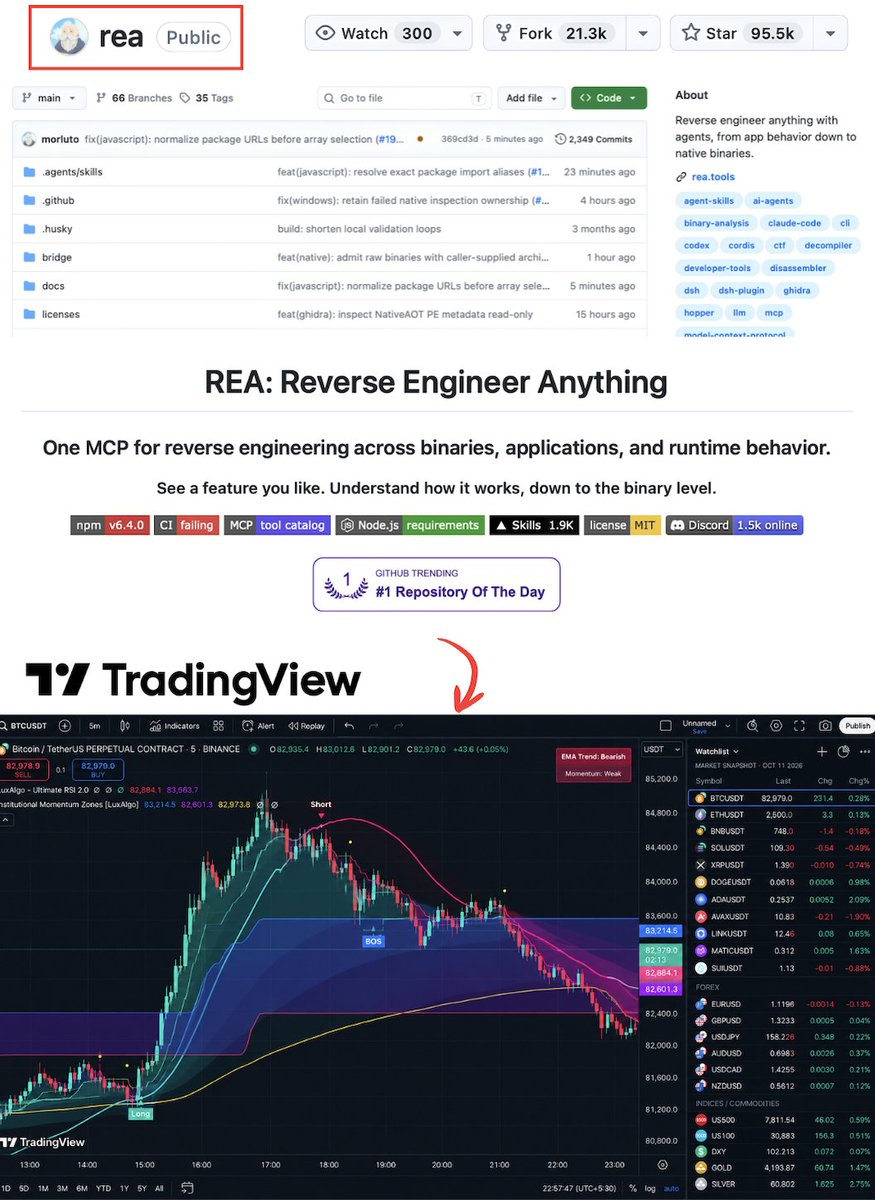
this is the most DANGEROUS thing on internet today REA (Reverse Engineer Anything) - this open source MCP lets your AI agent reverse engineer any app, down to the binary i just reverse engineered TradingView, now I am using their premium indicators for FREE - software is cooked here is how to use REA to reverse engineer TradingView: 1. point REA at TradingView's publicly observable interface and map every major feature, from chart interactions to indicators and alerts 2. trace how the interface behaves when you switch symbols, change timeframes, add indicators, draw levels, and update chart layouts 3. use REA's available MCP tools to investigate authorized software artifacts and trace application logic wherever the evidence allows 4. feed those findings into Claude Opus 5.5, which turns the investigation into a technical specification and an implementation plan 5. rebuild the charting engine independently, with real market data, candlesticks, technical indicators, drawing tools, and persistent watchlists 6. add a quant backtesting engine that tests strategies against historical data, accounting for fees, slippage, and drawdowns 7. test every component, compare its behavior against documented and observable results, fix failures, and keep iterating until the system actually works 8. you end up building your own TradingView-style quant research terminal from scratch, with source code you control and features you can keep extending i won’t say anything more:
Jev is the FASTEST AI model ever built for trading It makes calibrated buy/sell decisions in under 100 ms That is one real decision on every single block, 24/7 In this article I've shown EXACTLY how to build HFT trading system with Jev (from scratch) x.com/i/article/2100…
I JUST LAUNCHED 400 AI AGENTS WORKING SIMULTANEOUSLY. It’s not even about how fast they work, but the fact that they can’t lie to me I opened a real-time control center 400 instances of Claude Fable 5.1 generating data in parallel, with Jev running backend checks to verify every single output against its source. This goes far beyond a simple speedup. It’s a closed-loop ecosystem that won't stop until it eliminates every single discrepancy I directed them at 100 IT companies First pass 21 errors flagged, broken APIs, fabricated metrics, empty endpoints Second pass down to 7 failures Third pass clean sweep, zero errors This isn’t just another agent show-off. It’s an autonomous pipeline that catches its own mistakes before I even open my laptop If you know how to build this, you will never be out of a job If you don’t, the article below is made specifically for you

this is pure f*cking insane A secret Stanford AI research group found the right way to orchestrate Claude Opus 5.5, GPT-6.1 Sol, and Gemini 4 Argon together, and it completely breaks the agentic scaffolding wall most developers try to combine frontier models by chaining prompts in one context window or hardcoding rigid evolutionary loops. you burn tokens on context bloat and freeze models into contradictory schemas that out-date themselves within 5 iterations Stanford's architecture eliminates human-designed scaffolding and splits the cognitive stack: > context triage: Gemini 4 Argon ingests multi-million token codebases and strips raw AST syntax into typed interfaces (<24ms, -94.2% token compression) > candidate proposer: GPT-6.1 Sol explores high-entropy code variations inside isolated execution sandboxes (+18.4% candidate win rate) > causal director: Claude Opus 5.5 plans the search graph, querying persistent lineage where MAP-Elites and MCTS reduce to single Cypher queries > zero context bleeding: sessions reset after each iteration to prevent prompt bloat while the graph stores lineage > evaluator isolation: candidate code never touches the scoring process, stopping reward hacking and test leakage cold > meta-agent distillation: an offline meta-pass extracts verified lessons and updates search guidance across branches the benchmark metrics outclass standard discovery baselines: > 3.2x lower model spend than fixed evolutionary frameworks ($0.62 vs $4.90 per verified PR) > 1st place rank across competitive heuristic contests against human competitors > beats published SOTA on Anthropic kernel builder and 11 mathematical optimization tasks > 0% reward hacks: candidate-controlled metric tampering eliminated Argon filters context. Sol explores code. Opus directs the search graph you stop writing rigid search harnesses. you let frontier models own the discovery loop
@whimsicaljoycel Of course Milady Queen Whimsy The Foid from the House Targaryen! whateva thou want, thy wish is our command ! 🥰

whoever built this noticed we keep hiring the smartest model for the most boring work you pay $25-$250/mo for a brain that can research, code and plan… and a big chunk of its day goes to answering YES / NO. Jev takes that job off its plate. it's a small decision model that sits in front of the expensive calls and answers the boring forks: -> which agent runs next? -> worth researching or skip? -> reply or ignore? -> publish, wait or escalate? -> BUY / SELL / HOLD? -> click or keep looking? the reported numbers are what made the setup click for me. ~2,000 papers sorted for about $0.05 ~800 emails triaged for about $0.028 a browser-agent loop finished in ~6 seconds for ~$0.0029 and at $0.042 per million input tokens with free output, ~20,000 short decisions (~700 tokens each) lands near $0.62. Jev isn't out-thinking Claude here. it was never asked to think. the split is almost boring: -> big LLM does the research, writing and planning -> Jev makes the thousands of small calls in between -> code does the clicking, saving, sending and executing once you see it, the forks are everywhere. > inbox triage. > X replies. > support tickets. > meeting notes. > lead scoring. > clip picking. > browser agents. > even paper-trading loops. this is the part most agent setups get wrong. a frontier model shouldn't sit on every step just because it can. > Claude does the thinking. > Jev picks what's worth Claude's time. > code does the work. I mapped 12 spots to wire this into an agent today + the exact router config in the article below

5 confirmed updates at 8am, and permission to say nothing if nothing changed... that's the useful part of the overnight dot proposal: one recurring job, approved sources and a brief you can check without replaying an entire browsing session. alfred gives that idea a face. the yellow character sits inside a 6-lane terminal: look, think, map, act, check, keep. this is a visual concept, not footage of a working OpenAI agent. → look - read the approved sources → think - identify what actually changed → map - connect each claim to its evidence → act - prepare the morning brief → check - separate confirmation from inference → keep - preserve the record for the next run the proposed setup uses 3 pages: a runbook, an evidence ledger and the brief. the rules live in one place, the receipts in another. the morning output stays short because it doesn't have to carry the entire investigation. a teaser isn't a release. ten reposts aren't ten independent sources. yesterday's rumor doesn't become confirmed because an agent found it again overnight. publishing remains a separate approval step, enforced through actual permissions. a sentence telling the agent to behave is not a security boundary. if the sources don't support a story, silence is the correct output.


this is pure f*cking treasure 8 GitHub repos that turn Opus 5.5 into a real coding system: built for Opus 5.5 1. Serena: finds the right symbols and references before the model guesses github.com/oraios/serena 2. gitingest: packs the whole repo into prompt-friendly context github.com/coderamp-labs/… 3. OpenHands: the agent loop that writes and iterates inside the repo github.com/All-Hands-AI/O… 4. E2B: runs the generated code in an isolated sandbox github.com/e2b-dev/e2b the proof layer 5. Playwright: checks the UI path actually works github.com/microsoft/play… 6. promptfoo: evals the agent behavior in CI before you trust it github.com/promptfoo/prom… 7. Langfuse: traces every call so you see where it broke github.com/langfuse/langf… memory that survives the session 8. Mem0: keeps project memory across runs github.com/mem0ai/mem0 the stack in one line: Opus 5.5 decides, Serena and gitingest feed it, OpenHands acts, E2B and Playwright prove it, Langfuse and Mem0 remember. check each repo before you install. save this.


Anthropic engineer Adam Wolff dropped a Claude Code prompt that turns messy failures into a system that can debug itself this is f**king sharp… feed it the broken prompt + real failures, and it buckets the damage, builds an eval, then rewrites only what actually moves the score paste it into Claude Code and let the failures design the fix ↓


Reverse Engineer Anything 😂 Software is done.

@whimsicaljoycel Heil Queen of the Andals the Rhoynar n the 1rst Men, n of the 7Kingdoms Khaleesi of the Great Grass Sea Protector of the Realm Ruler of Dragonstone!😍 Thy cutiepieness is beyond comprehension! A gift that heals all the burden of our mundane quotidian routines! 🥰🥰🥰🥰
@whimsicaljoycel ill be da first to Heil thou, my Queen, before Sir Keinwood The Genius! so Heil Milady Whimsy The Foid from da House of Targaryan !!! thou divine angelic mega ultra cutie-pie presence is welcomed by thy humble peasants !!! 🥰Vielen Dank Milady Khaleesi Mother of Dragons! 😍🥰
@RKeinwood @whimsicaljoycel 🤣🤣🤣 from now on ill be known as Sir Dude The Bruh from the House of Dumbassness !!!!!! 🤣😂😅 Heil Sir Keinwood, Heil Milady Whimsy, Heil MiLord Boyfriend The Chud !!!!!!!!1 😍😍😍
@RKeinwood @whimsicaljoycel yyyyeessssssszzzzzz !!! Sir Keinwood The Genius is right !!!! Milady doesnt need to use nonnatural embellishments on heir divinity !!! Natural Milady Whimsy is beyond perfection n proud must be for being a Targaryan !!!! 🤣😍😝

Em & echo @MagdalenaWyszy2
16 Followers 890 Following glittery emotional support system ✨ follow back guaranteed
Dr. Wending Mai @maiwending
3K Followers 2K Following Researcher in electromagnetism | IEEE Senior Member | Optica Life Member | ACES Life Member | AAAS Member
engineers@work @engineerswork1
284 Followers 366 Following Website: https://t.co/fXslcuCV6H Git: https://t.co/Jjh6Pbshb5 Gyrocopters: https://t.co/Cb6U0p0riH
Amisha Yadav @amisha_explains
4K Followers 188 Following • Insights on tech, beauty & digital products • DM for paid collaborations: 📥 [email protected]
Nature Photonics @NaturePhotonics
18K Followers 64 Following A journal that publishes top-quality, peer-reviewed research in all areas of optics and photonics, e.g. light generation, propagation, manipulation & detection.
IEEE Photonics Societ... @IEEEPhotonics
13K Followers 2K Following Global professional home for scientists & engineers who advance laser, optics & photonics tech for the benefit of humanity. #Ally #OneIEEE
Maxinomics @maxinomics
71K Followers 188 Following Follow the money ▫️https://t.co/SzK8imsCzU ▫️by @phlndrws & @morningbrew
EPIC Photonics @EPIC_photonics
6K Followers 876 Following EPIC is the industry association that promotes the sustainable development of organisations working in the field of photonics in Europe.
Opto-Electronic Advan... @OptoElectronAdv
2K Followers 1K Following #OpenAccess SCI Journal #quntum #nano #optics #photonics #laser #optoelectronics #metamaterials #photovoltaics #2D #ImpactFactor = 22.4(#JCR 2025)
Dr. Wending Mai @maiwending
3K Followers 2K Following Researcher in electromagnetism | IEEE Senior Member | Optica Life Member | ACES Life Member | AAAS Member
EPFL @EPFL
56K Followers 1K Following Bienvenue sur le compte officiel de l'EPFL. English account: @EPFL_en
EPFL Center for Quant... @QSECenter_EPFL
1K Followers 227 Following The EPFL Center for Quantum Science and Engineering (QSE) is a hub for cross-disciplinary research, education and innovation in quantum science and engineering.
Quantinuum @QuantinuumQC
14K Followers 21 Following We’re advancing quantum computing to solve the world’s most pressing challenges
PsiQuantum @PsiQuantum
13K Followers 63 Following Building the world’s first useful quantum computers.
IonQ @IonQ_Inc
66K Followers 110 Following The world's leading quantum platform and foundry, delivering integrated quantum solutions across computing, networking, sensing, and security. $IONQ
European Research Cou... @ERC_Research
156K Followers 538 Following European Research Council, set up by the EU, funds top researchers of any nationality, helping them pursue ideas at the frontiers of knowledge. 🦋https://t.co/Y9s8R2t8Qr.

Hugging Apps @HuggingApps
5K Followers 3 Following Tweeting the coolest apps and demos on @huggingface Spaces curation by @multimodalart
IQM Quantum Computers @IQMquantum
10K Followers 361 Following IQM is the global leader in quantum computing. Offices: Espoo, FI; Munich, DE; Paris, FR; Singapore, SG; Warsaw, PL; Palo Alto, US
BigScience Research W... @BigscienceW
14K Followers 1 Following A research workshop on large language model gathering 1000+ researchers around the world Follow the training of the 176B multilingual model live @BigScienceLLM
Urs Schreiber @UrsSchreiber
2K Followers 0 Following mathematical fundamental physics at New York University in Abu Dhabi, Center for Quantum and Topological Systems (NB: previous handle was @SchreiberUrs)
IEEE Quantum Week @IEEEQuantumWeek
3K Followers 201 Following IEEE Intl Conference on #QuantumComputing & Engineering (#QCE26) showcases quantum computing research, practice, applications, education, and training.
Xanadu @XanaduAI
16K Followers 213 Following Our mission: To build quantum computers that are useful and available to people everywhere. We are hiring! https://t.co/c4NPQqa8Oz
QC Ware @QCWare
7K Followers 144 Following Enterprise Software and Services for #QuantumComputing https://t.co/KfYEuNo2U5 https://t.co/NknCmffrc7 https://t.co/Cu97MEoZhl
PennyLane @PennyLaneAI
9K Followers 123 Following @XanaduAI's PennyLane is an open-source software platform for quantum computing, ML, & chemistry. Build meaningful algorithms from inspiration to implementation
Quantiki @quantiki
9K Followers 296 Following Quantiki, the leading portal for everyone involved in quantum information science. Managed by @jarekadam. Also at https://t.co/U3nQgu1I6H
Joint Quantum Institu... @JQInews
9K Followers 67 Following The Joint Quantum Institute is a research partnership between @UofMaryland and @NIST, with support from LPS. Scientists researching the quantum world.
Q-CTRL @qctrlHQ
11K Followers 155 Following Make quantum technology useful. The first to achieve quantum advantage through AI-powered software. Subscribe to our newsletter: https://t.co/E54SKrIQVl
Horizon Quantum @horizon_quantum
8K Followers 128 Following A pioneer of software infrastructure for quantum applications. $HQ
Quantum Internet Alli... @eu_qia
4K Followers 48 Following The Quantum Internet Alliance (QIA) is a team of world-leading research institutes & industry actors building a global Quantum Internet made in Europe.
Quantum.Tech @QuantumTech_
3K Followers 391 Following The global business conference & exhibition for commercial applications of Quantum technology.
The Quantum Insider @QuantumDaily
25K Followers 1K Following The leading provider of media and market intelligence on the quantum market. Part of Resonance.
Nature Physics @NaturePhysics
531K Followers 794 Following A journal for cutting-edge physics research. Facebook: https://t.co/R7YLdoW5ym… Instagram: https://t.co/1kC90d1rgc
Physical Review B @PhysRevB
19K Followers 92 Following @APSPhysics journal specializing in condensed matter & materials physics.
Quantum Flagship @QuantumFlagship
12K Followers 185 Following Bringing together scientists, engineers, industry and future users of quantum technologies. Welcome the second quantum revolution!
QuICS @JointQuICS
6K Followers 97 Following QuICS is a partnership between @UofMaryland and @NIST. We advance research and education in quantum computer science and quantum information theory.
Quantum Device Lab @qudev
10K Followers 848 Following @QuDev (the Quantum Device Lab of ETH Zurich), led by @AndreasAtETH, we explore #quantum circuits for #computing, #communication and #sensing technology.
Springer Physics @SpringerPhysics
18K Followers 316 Following We publish over 200 Physics journals and 350 books/year, online and in print. We also offer Open Access options. Contact our Publishing Editors today.
MIT Physics @MIT_Physics
39K Followers 136 Following The official account for the MIT Department of Physics
Physics Magazine @PhysicsMagazine
76K Followers 513 Following Exploring the people, ideas, and stories behind physics research.
Physical Review Lette... @PhysRevLett
75K Followers 168 Following The world’s most-cited journal in multidisciplinary physics.
Physical Review X @PhysRevX
23K Followers 171 Following @apsphysics' open access journal for cutting-edge research across physics and adjacent fields
PrincetonPhysics @PrincetonPhys
11K Followers 64 Following Empowering Minds and Transforming Tomorrow through Cutting-edge Physics Education and Research at Princeton University.
CERN @CERN
2.4M Followers 447 Following CERN is the European laboratory for particle physics, home to the #LHC. — All media © CERN, human-generated unless otherwise stated. French: @CERN_FR

American Physical Soc... @APSphysics
256K Followers 254 Following Fostering a vibrant, inclusive, and global community dedicated to science and society. Join us: https://t.co/Jvs055fiDM
NVIDIA AI Infrastruct... @NVIDIAAIInfra
84K Followers 2K Following AI factories for the era of AI reasoning.
Phys.org @physorg_com
1.0M Followers 202 Following Science news, Technology news. Physics, Space, Biology, Chemistry, Engineering, Math, Electronics, Nanotechnology, Materials, Computers, Health, Earth Science.
NVIDIA AI Developer @NVIDIAAIDev
112K Followers 386 Following This account is inactive. Follow @NVIDIAAI for the latest updates.
Quantum Physics Corne... @quant_phys
53K Followers 514 Following Nuts and bolts of quantum mechanics
Stanford AI Lab @StanfordAILab
275K Followers 335 Following The Stanford Artificial Intelligence Laboratory (SAIL), a leading #AI lab since 1963. ⛵️🤖 Emmy-winning video: https://t.co/lV9smZTC1m
NVIDIA HPC Developer @NVIDIAHPCDev
57K Followers 684 Following See the latest HPC developer news and resources from @NVIDIA. Be sure to check out our NVIDIA Technical Blog for more.
Veritasium @veritasium
518K Followers 547 Following An element of truth - videos about science, education, and interesting things. https://t.co/pZUf3POBErYou might like


















