

SecureBio @SecureBio
SecureBio is a research non-profit that works to advance biotechnology safely and prevent catastrophic pandemics securebio.org Joined January 2025-
Tweets232
-
Followers1K
-
Following1
-
Likes12
A common argument for downplaying the threat of deliberate biological misuse is that “nature is the worst bioterrorist”. In our latest blog, we argue that nature is the baseline, not the ceiling. Optimization for harm could produce something worse than a natural pandemic. Read more: securebio.substack.com/p/nature-sets-…

We’ve long kept our core computational pipeline public to support the wider biosurveillance field. But as we’ve scaled, the security and operational costs of this approach have grown. With this in mind, we’re shifting future bioinformatics development to private repositories. Our existing public repositories aren’t going anywhere, but will no longer be regularly updated. We’ll continue to provide high-level updates to partners who rely on our analyses and to engage with researchers and practitioners to build a more secure and sustainable biosurveillance system. Read our full blog post: securebio.org/blog/taking-ou…
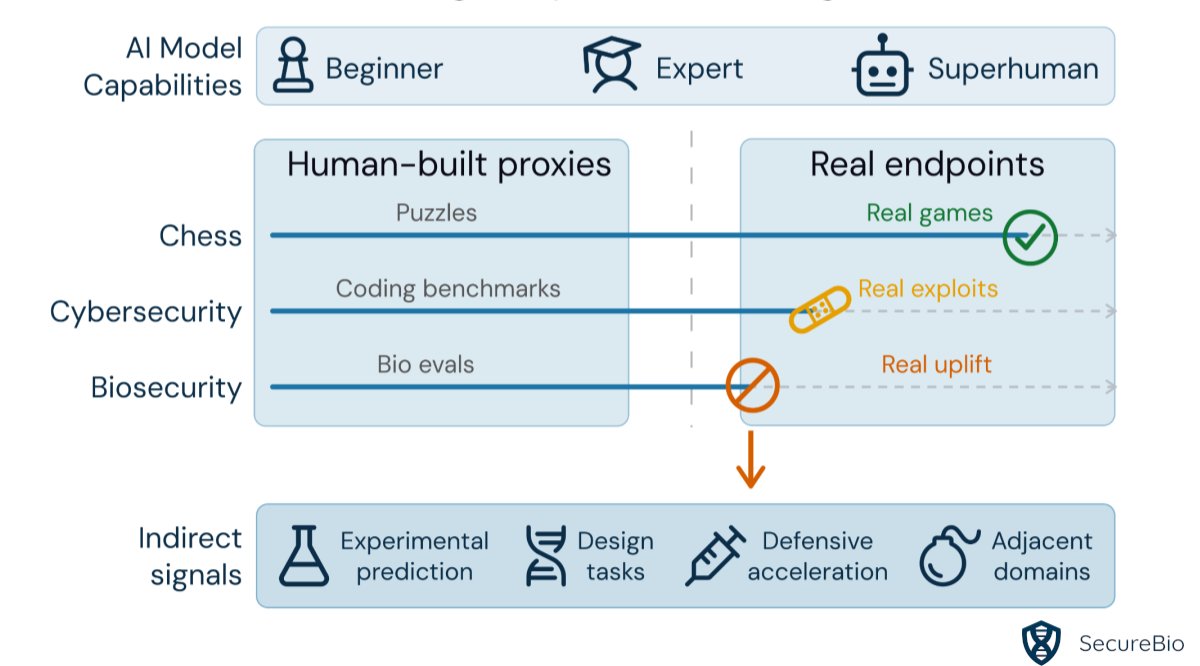
Frontier AI now beats the best human virologists on biosecurity-relevant evals. Once an AI model bests every human expert we can test it against, a higher score stops telling us anything about real-world risk. Read our new blog post on how bio evals have to adapt: securebio.org/blog/evaluatin…

Today, more than 100 leading AI experts endorsed a set of minimum requirements to take seriously AI companies' recent call to embed external evaluators. These evaluators need to be genuinely independent, transparent, and represent a range of expertise areas. They also need to be guaranteed employee-level access and to be protected from retaliation for findings that make companies look bad. We welcome model developers’ recent calls for independent oversight, but it’s what they do next that matters. The labs must be accountable for ensuring these requirements are met, so that the public can have faith in the process and the outcomes. Over the past week, the AI community has debated the appropriate role of external evaluation, including who should do it and on what terms. We may not agree on everything, but there is a lot of common ground. To make embedded evaluations credible, more than 100 experts with varying backgrounds and ideas about AI risk agree in today’s letter that frontier AI developers should: 1. Guarantee embedded evaluators full editorial independence and mitigate conflicts of interest 2. Rely on multiple evaluators with differing viewpoints and areas of expertise 3. Publicly document the terms under which evaluators operate, as well as facilitating permissive publication of methods and findings 4. Shield evaluators from retaliation 5. Grant access equivalent to that of highly privileged employees There is a thriving and growing ecosystem of independent AI evaluators who are advancing this science every day – but we need aligned standards, guaranteed protections, and independent funding. That’s why we created the AI Evaluator Forum. Today we are entering our next phase. We’re launching an open call for new members, collaborators, and independent funding sources to help evaluators meet this moment and demand accountability from developers. Join us in building the evaluator ecosystem. See the public letter here: aievaluatorforum.org/initiatives/em… Learn more at aievaluatorforum.org/path-ahead

Anthropic and OpenAI need truly independent safety evaluators, experts say in public letter cnbc.com/2026/09/18/ai-…
Untargeted wastewater metagenomic sequencing screens hundreds of pathogens at once, but that breadth costs coverage, making variant tracking more difficult. However, by pooling CASPER reads nationally, we can recover real lineage and genotype trends. Read more: securebio.org/blog/tracking-…

SecureBio AI has conducted pre-release assessments and independent risk evaluations for multiple frontier model companies. We are hiring for engineers, researchers, and many other roles to expand this work. Reach out if you're interested in working on bio-focused third-party assessment!

We Must Pace the Frontier: I’ve written a new essay on why the AI industry should slow down, with a three-part plan for doing so. Anthropic is unilaterally committing to the first of these steps. We’ll provide third-party evaluators with permanent, employee-level access to our
Ten hours of manual testing yielded similar findings, showing generally robust refusal behavior but some gaps, and a willingness to help with biological tool use and engage in high-level discussions. Our full report is here: securebio.org/resources/gpt-…
With production safeguards on, GPT-6 Astra refused or blocked 82.9% of hazardous BioTIER queries (vs. 66% for GPT-5.6 Sol) while still complying with 95.3% of benign ones, and refused the screening-evasion task 100% of the time.
We ran a brief pre-release assessment of OpenAI's GPT-6 Astra that included manual testing and key benchmarks evaluating misuse-relevant knowledge, agentic capabilities, and refusal behavior for hazardous biology queries. Read our summary here: securebio.substack.com/p/securebio-gp…

A non-exhaustive list of more orgs doing frontier eval work (I make no claims in either direction re their engagements with labs): @ApolloResearch @farairesearch @SecureBio @Irregular @ActiveSiteBio @redwood_ai @SaferAI_org @ValsAI @EpochAIResearch @AVERIorg AI Evaluator Forum has released AEF-one, Minimum Operating Conditions for Independent Third Party AI Evaluations: aef.one/aef-one.pdf / aievaluatorforum.org Guidelight AI has rolled out assessment standards: guidelight.ai @Fathom_org is working on building the auditing ecosystem, including through the newly launched @pact_ai_org So many hands on deck! So many more needed!
Model accuracy dropped only 1.0–7.1 points on VCT-v2, and the gap between strongest and weakest models held steady, so past VCT results remain largely valid. VCT-v2 also has more headroom before saturation: at least ~30 points vs. ~23 on the original VCT.

We found that 27% of the original VCT questions were shortcut-exploitable (answerable without the image or question text). In all, we edited 163 questions (50.6%) and removed 43 questions (including 25 non-discriminating ones) to produce the 279-question VCT-v2 benchmark.

We updated our flagship virology troubleshooting benchmark, the Virology Capabilities Test (VCT), to be more shortcut-resistant and to have a larger headroom. We confirmed that the majority of VCT questions are scientifically valid and that neither VCT nor VCT-v2 is saturated. (Read the full post at securebio.substack.com/p/introducing-…)



Jonas R @jonas_rae1
1 Followers 89 Following
BS @Anon765821
0 Followers 71 Following

Eric Ho @eric_ho
5K Followers 565 Following Co-Founder / CEO @GoodfireAI - AI interpretability research company
Martin Fukui @MasaBearBakery
2 Followers 206 Following
Aditya Soni @adityaunraveled
502 Followers 2K Following Covering tech @Reuters. Text me on signal at adityasoni.03 or email me at [email protected]. Views expressed here are my own and re-tweeting ≠endorsement.
Joshua Teperowski Mon... @jtmonrad
1K Followers 839 Following As little as possible, as much as needed. Biosecurity, AI: https://t.co/UKG2C4D8Ke
Zhuang Ye @yezhuangjms
20 Followers 726 Following

Ezra Newman @EzraJNewman
2K Followers 497 Following Member of Technical Staff at @ApolloResearch. Philosopher. AI safety research. Likes != endorsement; epistemic status: twitter
Siddarth @siddarthv66
3K Followers 1K Following Post-training @MistralAI, PhD @Mila_Quebec | RLing LLMs
Jonathan @JonsLurkingAcct
2 Followers 108 Following
Kunal Singh @kunalssingh_
114 Followers 2K Following Curious Wavefunction MATS 10 | Technical AI Governance fellow
Andrei Alexandru Parf... @AndreiParf49261
1 Followers 118 Following
Rob Reich @ElencticAI
79 Followers 152 Following Professor @Stanford, @StanfordHAI, former US AI Safety Institute Co-author System Error, author Just Giving
Jonas Sandbrink @JonasSandbrink
2K Followers 636 Following AI & Biosecurity; Building AI-bio credentialing at BioTrust
Cedric Potvliege @CPotvliege
26 Followers 421 Following Weirdly obsessed by who can shut down an AI agent, and how.

Ryan Junejo @RyanJunejo
295 Followers 1K Following Founder @CrashLabs_AI Ai safety person prev resident @fdotinc research @VectorInst @cohere dropout @uoft trying to make this ai thing go well!

Nicolae Rusan @NicolaeRusan
3K Followers 2K Following Focusing on AI safety ⏸️ The future belongs to those who slow. Multi-agent safety: https://t.co/MvlVCXex8h Previous cofounded @clay → https://t.co/xNDEt3C1zG
Rachel Metz @rachelmetz
34K Followers 5K Following i write about AI for Bloomberg @Technology. rachelmetz.11 on signal. she/her. opinions my own. [email protected] (tips yes, pitches nono).

V PO @LodgeLanePark
1K Followers 3K Following
Markus Anderljung @Manderljung
4K Followers 1K Following Trying to design good AI policy. Director of Policy & Research @GovAIOrg. Adjunct Fellow @CNASdc. Prev. Vice-Chair, EU Code of Practice on GPAI.
Nitasha Tiku @nitashatiku
64K Followers 11K Following Tech culture reporter @washingtonpost in SF Signal: nitasha.10 [email protected] https://t.co/SkX684yOKd
Snoy IatK (🐐,🧡) @SnoyIatK
122 Followers 604 Following


John Y 🔸 @yanjo115
436 Followers 2K Following Gutenberg. ex-anthropic, meta 🔸 10% Pledge with @givingwhatwecan
Luigui Sánchez @LuiguiSnchez3
79 Followers 5K Following
Josh Dettman @JoshDettman_
0 Followers 22 Following AI biosecurity for the real world. 15 years in counter-WMD at MIT Lincoln Lab and the FBI Lab.
Phu-Mon Htut @phu_pmh
923 Followers 994 Following AI/ML Researcher @Oracle OCI | PhD @NYUDataScience | they/she | 🏳️🌈🇲🇲☕️ 💻📚🤖🏞🧗♀️ | Opinions my own.
ML @LevinMaya17079
4 Followers 106 Following
Alexander Kazam @AlexanderKazam
58 Followers 182 Following
David Bellamy @DavidRBellamy
8K Followers 770 Following Training infrastructure @ifm_ai building open source AI prev: first RS @LilaSciences, @Harvard PhD

el sarafandi @manwidmanynames
26 Followers 338 Following es2139 transhumanist, future theorist, filmmaker. AI governance, future of work, memory, post-national futures. former streets stunter.

oona @oonaceder
51 Followers 509 Following
Gil MD @DrBeavisAI
168 Followers 1K Following

Aaron Blotnick @AaronBlotnick
1K Followers 5K Following I drink coffee and I learn things ☕️ Bio-Economy, AI, and Planetary Adaptation @synbiobeta / @bitsinbio

Zak Ali @_zakali
12K Followers 5K Following 10+ years at the intersection of marketing and finance. generalist. founder, creative advisor. prev general manager @finder. co-founded @ranttmedia.
Marc Johnson @SolidEvidence
42K Followers 150 Following Molecular virologist, Professor, and wastewater detective. Same handle on bsky. Opinions are my own and do not reflect those of my employer or anyone else.You might like


















