

Skylab Intelligence @skylabintel
Supply-chain intelligence for the AI era. From semiconductors to frontier labs and the infrastructure behind it all. skylabintel.substack.com Joined September 2026-
Tweets181
-
Followers3K
-
Following79
-
Likes2K
@natebirdman You need to use Higgsfield MCP or similar. Its more about Claude's taste and tool use than creating them from scratch
Taiwan exported $5.21 billion TWD of SSDs and other solid-state flash-storage devices in August–September, up 12.4% from June–July. Imports reached $3.49 billion, up 26.1% over the same comparison. Exports exceeded imports by $1.72 billion across the two months. Taiwan’s storage industry combines NAND with controllers, firmware and drive engineering. Phison designs controllers, integrates storage modules and sells their own eSSDs. It names Kioxia, Micron, Sandisk, Samsung, SK hynix and YMTC as long-term NAND partners. DRAM also enters this chain. Kioxia signed a long-term supply agreement with Nanya this year specifically to secure DRAM components for its expanding SSD business. A finished drive connects NAND supply, DRAM supply and the controller ecosystem. $8299.TWO Phison | $285A.T Kioxia | $2408.TW Nanya Technology | $DRAM Roundhill Memory ETF | $SIMO Silicon Motion

Taiwan imported TWD $514 million of MLCCs in August and September, up 19.6% from June–July. Exports reached $343 million, up 6.9% over the same comparison. MLCCs sit around CPUs, GPUs and memory, Yageo maps its MLCC technologies to those power rails and to high-ripple-current conversion stages. Murata’s AI-server power portfolio also includes MLCCs, with smaller, higher-capacitance devices addressing increasingly dense electronics. $2327.TW Yageo | $MRAAY Murata Manufacturing | $PSOX Tema MLCC & Power Semi ETF

Winbond disclosed NT$4.89 billion of equipment purchases from Lam Research and Applied Materials in filings dated October 14 and 16. • Lam Research: NT$3.22 billion, covering May 22–October 16. • Applied Materials: NT$1.67 billion, covering May 22–October 14. Winbond makes specialty DRAM, NOR flash and SLC NAND used in servers, networking, vehicles and industrial electronics. In its August earnings release, the company said AI-related demand was driving its customized-memory business, while newer SLC NAND products were contributing more flash revenue. Lam and Applied supply deposition and etch equipment that builds and shapes the layers inside memory chips. These filings identify two major US equipment suppliers participating in Winbond's manufacturing investment. $2344.TW Winbond | $LRCX Lam Research | $AMAT Applied Materials

Semtech is targeting $2.1 billion of data-center revenue in fiscal 2030, up from about $200 million in fiscal 2026. Management expects the business to more than double in both FY2027 and FY2028. The plan is built around analog chips that drive, receive and equalize high-speed signals across optical modules and active copper links. As AI clusters move from 800G and 1.6T toward 3.2T, Semtech expects to sell more components into each link. The company says its expanded photonics portfolio creates an opportunity for more than 10 times the content in an optical module. Semtech is aligning roadmaps with multiple hyperscalers and module manufacturers. Tower Semiconductor is the confirmed foundry partner securing SiGe capacity across the United States, Israel and Japan for those signal-integrity products. $SMTC Semtech | $TSEM Tower Semiconductor

@DeepDishEnjoyer @0xFaust12 A lot of the neoclouds and semicap are below july lows
Schneider Electric says data-center demand grew at a triple-digit rate in the third quarter as group revenue reached a quarterly record EUR11.46 billion, up 16.9% organically. Schneider supplies the electrical and cooling infrastructure around AI racks: switchgear, power distribution, UPS systems, server racks and liquid-cooling equipment. That positions the company between utility power and the compute hardware installed inside the data center. US hyperscalers sustained orders, while China and East Asia led quarterly growth through direct sales to large social-media, and digital-infrastructure customers plus local and regional colocation operators. The backlog and data-center demand gave Schneider increasing visibility into 2027 and 2028. The company lifted its 2026 organic revenue-growth target to 12%-14% and its adjusted EBITA growth target to 18%-21%. $SU.PA Schneider Electric | $POW Vistashares Electrification Supercycle ETF | $VST Vistra Corp

Netherlands WFE exports reached EUR2.12 billion ($2.42 billion) in July, up 62.4% from a year earlier. Taiwan received $751.1 million, South Korea $602.3 million, China $553.1 million and the United States $478.6 million. Together, the four destinations accounted for 98.6% of July exports. The move combined higher shipment weight and a higher-value mix. Export weight rose 31.5% year over year, while customs value per kilogram increased 23.5%. • Taiwan: TSMC and Micron • South Korea: Samsung and SK hynix • United States: Intel and Micron. • China: SMIC and Hua Hong Group. • Japan: Kioxia, Micron and Sony. The memory connection runs through DRAM and NAND. Micron uses ASML equipment across Taiwan, Japan and its Boise operations, while SK hynix has installed ASML’s High-NA EUV system at its M16 fab in Icheon. In Japan, Kioxia’s Yokkaichi and Kitakami fabs underpin its NAND manufacturing partnership with Sandisk. $ASML ASML | $TSM Taiwan Semiconductor | $MU Micron

ASML’s advanced-packaging push is widening. Reuters reports that SemiAnalysis reviewed 27 ASML patent filings indicating development of a hybrid-bonding system. Besi is the incumbent leader in hybrid bonding, which joins dies or wafers with direct copper connections for dense 3D packages. ASML already shipped its first advanced-packaging product in 2025: the TWINSCAN XT:260, an i-line scanner for 3D integration that offers up to four times the productivity of existing solutions. A hybrid-bonding system would extend ASML from patterning packaging layers into the joining step itself, putting it closer to Besi’s core equipment market. Besi shares fell 3% after the report; ASML shares rose 1.1%. Besi’s October partnership with Applied Materials shows the competitive response. The two companies are jointly developing hybrid bonding, thermocompression bonding, panel integration and photonics at Applied’s EPIC Center. $ASML ASML | $BESIY BE Semiconductor Industries | $AMAT Applied Materials

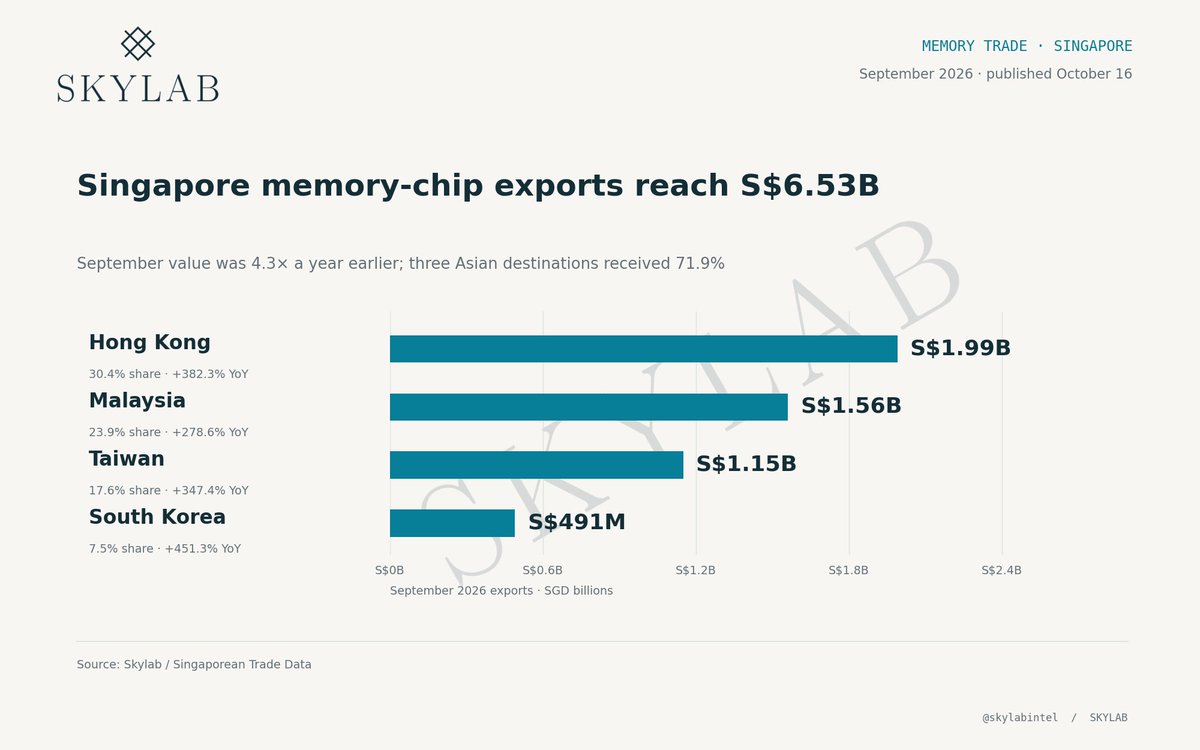
Singapore's memory-chip exports reached S$6.53B in September, up 330% from a year earlier. The category spans DRAM, NAND and HBM chips. Hong Kong, Malaysia and Taiwan received S$4.70B, or 71.9% of the total. Each route grew at least 278% year over year. Across all integrated circuits, Singapore exported S$26.99B in September, up 49.4% year over year and 12.7% from August. $MU Micron | $LRCX Lam Research | $AMAT Applied Materials
The Daily DRAM | October 16, 2026 (as of Asia close) DDR5 extended its weekly lead, while DDR4 was largely flat and DDR3 rebounded. • DDR5 16Gb (4800/5600): $60.600 | Day +0.28% | Week +2.89% • DDR5 16Gb eTT: $28.000 | Day +0.72% | Week +4.48% • DDR4 16Gb (3200): $83.660 | Day 0.00% | Week +0.02% • DDR4 16Gb eTT: $14.113 | Day 0.00% | Week -0.08% • DDR4 8Gb (3200): $45.971 | Day 0.00% | Week -0.47% • DDR4 8Gb eTT: $5.968 | Day -0.03% | Week +0.13% • DDR3 4Gb (1600/1866): $13.751 | Day +0.52% | Week +0.31% $MU Micron | $SKHY SK hynix | $DRAM Roundhill Memory ETF

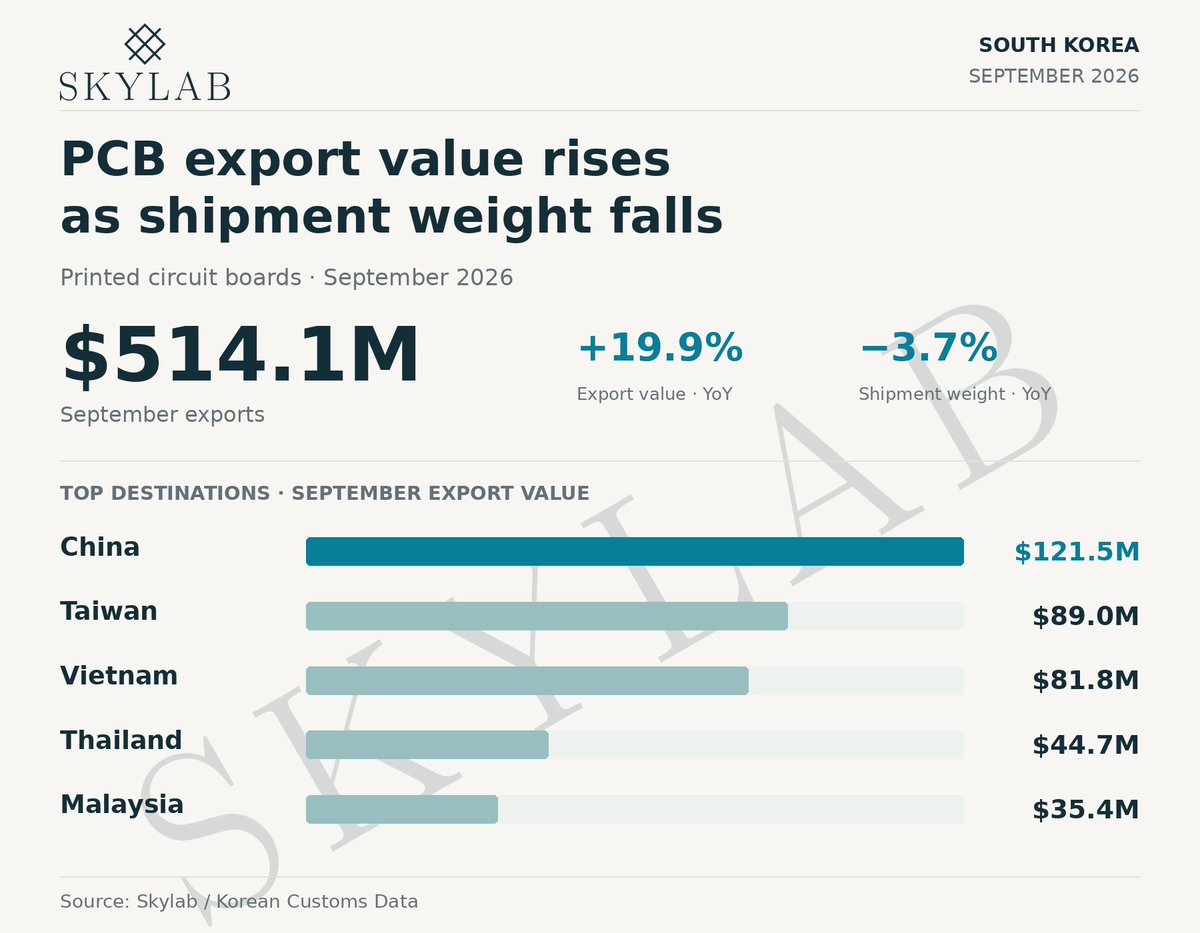
Korea’s printed-circuit-board exports rose 19.9% year over year in September to $514.1 million, even as shipment weight fell 3.7%. Export value per kg increased 24.6%, reflecting a combined effect of pricing and product mix. China received $121.5 million, Taiwan $89.0 million and Vietnam $81.8 million. The fastest growth among the five largest destinations came from Thailand, up 92.1% to $44.7 million, and Malaysia, up 67.8% to $35.4 million. Vietnam fell 13.8%. All three Southeast Asian countries are increasingly important for backend package, test and assembly. Chip-package substrates are attracting investment too. On September 29, Samsung Electro-Mechanics announced KRW6.78 trillion of planned FC-BGA investment across Korea and Vietnam. These substrates connect high-performance chips to the mainboard. New Sejong production is targeted for September 2028, with Vietnam’s expansion targeted for June 2030. The trade signal is already visible: Korea is exporting more PCB value in a smaller shipment weight, while suppliers prepare additional capacity for complex AI hardware. $007660.KS ISU Petasys | $222800.KQ Simmtech | $009150.KS Samsung Electro-Mechanics | $TTMI TTM Technologies
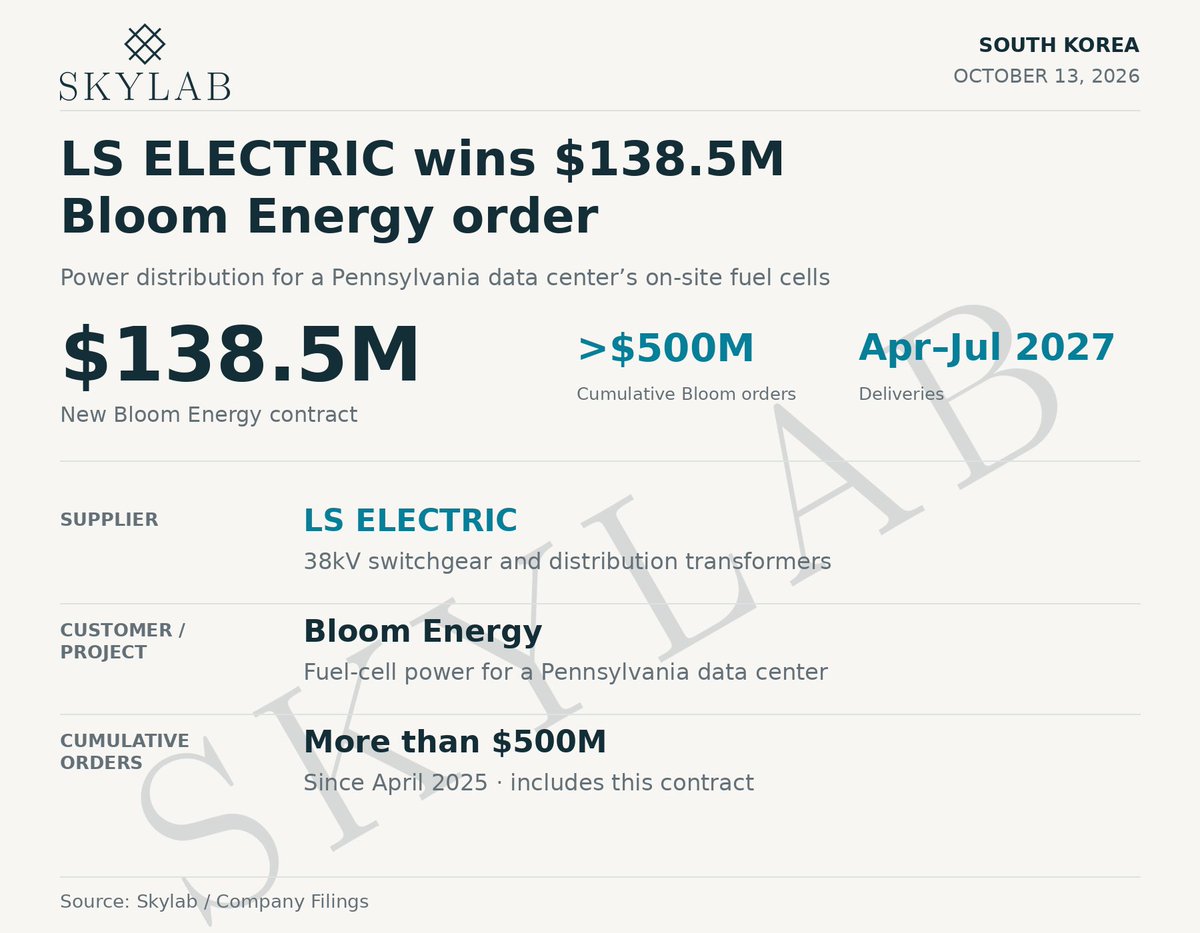
LS ELECTRIC has won a $138.5 million order from Bloom Energy for the electrical equipment around a Pennsylvania data center’s fuel-cell power system. The October 13 announcement covers 38kV switchgear and distribution transformers, with deliveries scheduled for April–July 2027. It takes LS ELECTRIC’s cumulative Bloom orders above $500 million since April 2025. Generating power on site creates demand for the equipment that gets it to the servers. Fuel cells make electricity; transformers change its voltage, while switchgear directs power and protects electrical circuits. LS ELECTRIC is supplying those systems together. Korea also supplies the generation hardware. In a separate October 6 announcement, Doosan Enerbility confirmed shipment of a 380MW gas turbine from Changwon for SpaceXAI’s US infrastructure. These projects put Korean equipment on both sides of the data-center power buildout: producing electricity and distributing it through the facility. $010120.KS LS ELECTRIC | $BE Bloom Energy | $034020.KS Doosan Enerbility
Korea's exports of assembly and packaging machinery reached $266.6 million in September, up 109.4% from a year earlier and 31.8% from August. China received $106.5 million in September, Taiwan $82.1 million and Singapore $34.8 million. Together they accounted for 83.8% of exports in this category, which covers equipment such as die bonders, wire bonders and wafer handlers. Hanmi Semiconductor is one Korean supplier serving this production stage. Its SEMICON West lineup includes HBM thermocompression bonders, which join stacked memory chips, and bonders for packages that place multiple chips together. $042700.KS Hanmi Semiconductor

About 80% of Camtek's more than $800 million in orders received this year came from advanced packaging, the company disclosed at SEMICON West. More than half came from outsourced assembly-and-test providers. Camtek expects preliminary Q3 sales of $160–161 million, up 27% year over year, followed by roughly $180 million in Q4, up 40%. Its initial 2027 revenue outlook exceeds $800 million, against approximately $595 million expected for 2026. Camtek makes equipment that finds defects and measures tiny structures on chips and wafers. Its Hawk systems address chiplets, high-bandwidth memory and hybrid bonding. Eagle G5 covers the fine wiring layers used in advanced packages. As packages add layers and connections, manufacturers need more inspection and measurement steps. $CAMT Camtek

Micron opened a new advanced assembly-and-test facility in Taichung, Taiwan and COO Manish Bhatia said all of the capacity it will build in 2027 is already sold out. This is a back-end memory plant for packaging and testing DRAM and HBM. Micron expects HBM demand to grow faster than the rest of the DRAM market through 2028. $MU Micron | $NVDA Nvidia | $DRAM Roundhill Memory ETF

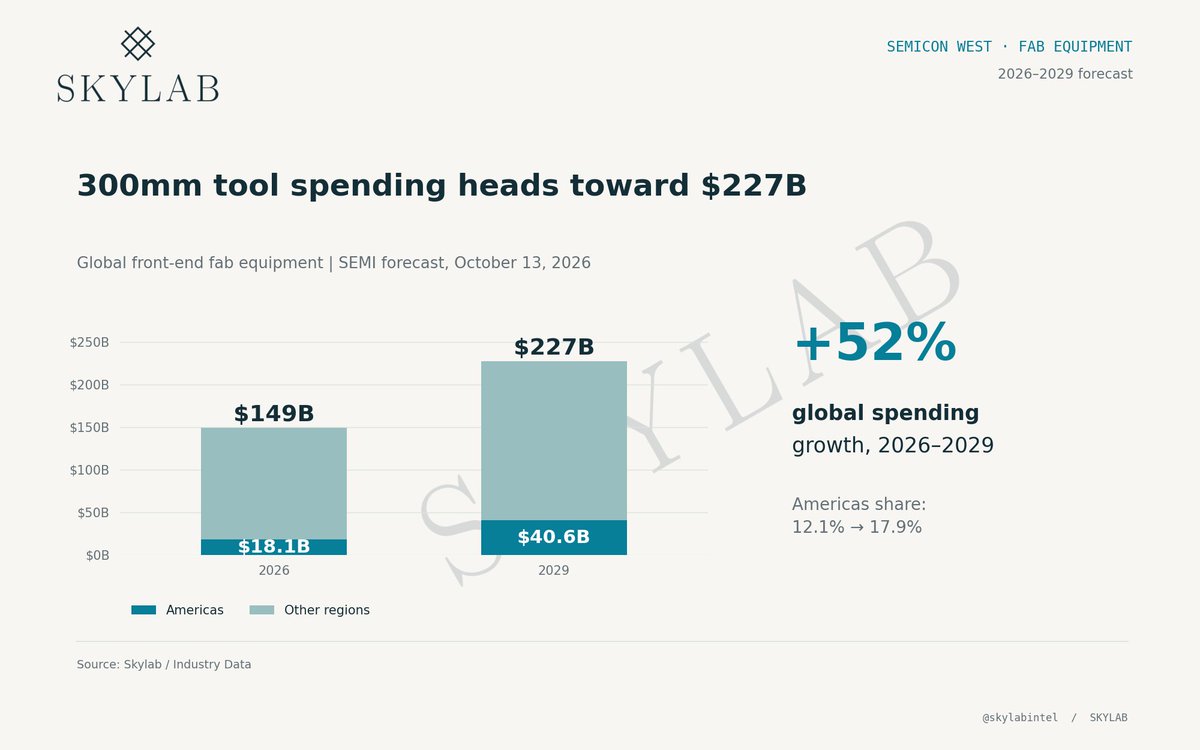
SEMI expects global spending on equipment for 300mm wafer fabs to reach $149 billion in 2026 and $227 billion in 2029, a 52% increase across the period. The Americas are projected to grow faster: from $18.1 billion to $40.6 billion. That would lift the region's share of global spending from 12.1% to 17.9%. The October 13 outlook covers front-end equipment used to manufacture chips on wafers. This includes the production stages served by ASML's lithography systems and Applied Materials' deposition and etch tools. SEMI also expects 20 new 300mm fabs or production lines to start construction worldwide in 2026 and 18 in 2027, excluding pure research facilities. $ASML ASML | $AMAT Applied Materials | $LRCX Lam Research
U.S.-bound DRAM module shipments supplied 68.9% of the increase in Korea's exports between August and September. Korea exported $16.48 billion of modules in September, up 110.4% from August and 574.1% from a year earlier. Modules are circuit boards carrying memory chips, including the DIMMs used in servers and PCs. Shipments to the United States rose from $3.82 billion to $9.78 billion. That $5.95 billion increase accounted for most of the $8.65 billion worldwide monthly gain. The U.S. share rose from 48.8% to 59.3%. The annual increase was much larger in dollars than in shipment weight: value rose 574.1%, while weight increased 4.6%. Customs value per kilogram, a measure combining pricing and product mix, rose 544.4%. These assembled modules sit outside Korea's $37.59 billion memory-chip export total. Including modules brings the broader September memory export value to $54.07 billion. A concrete example of the product is SK hynix's 6,400 MT/s DDR5 registered memory module, certified for Dell's R770 server and shown at Dell Technologies Forum in August. $SKHY SK hynix | $DELL Dell Technologies | $DRAM Roundhill Memory ETF

The Daily DRAM | October 15, 2026 (as of Asia close) DDR5 rose again, while DDR4 was mixed and legacy DDR3 edged lower. • DDR5 16Gb (4800/5600): $60.433 | Day +0.55% | Week +3.01% • DDR5 16Gb eTT: $27.800 | Day +1.09% | Week +4.51% • DDR4 16Gb (3200): $83.660 | Day +0.06% | Week +0.02% • DDR4 16Gb eTT: $14.113 | Day -0.09% | Week -0.08% • DDR4 8Gb (3200): $45.971 | Day 0.00% | Week -0.92% • DDR4 8Gb eTT: $5.970 | Day 0.00% | Week +0.34% • DDR3 4Gb (1600/1866): $13.680 | Day -0.04% | Week -0.29% $MU Micron | $SKHY SK hynix | $DRAM Roundhill Memory ETF

JUST IN: $TSM reported another record quarter Q3 revenue reached $46.72 billion, up 41.2% year over year in US dollars and 16.2% from Q2. Net profit rose 68.7% to NT$763.06 billion, or about US$23.9 billion at the quarter’s average exchange rate. Earnings reached $4.60 per ADR. Revenue beat the top of TSMC’s $44.6–45.8 billion guidance by $920 million. Operating income climbed 75% to NT$876.45 billion. Gross margin was 66.4%, operating margin 58.7%, and net margin 51.1%. AI and high-performance computing: High-performance computing accounted for 68% of total company revenue, up from 57% a year earlier. HPC revenue grew another 22% sequentially. The business spans AI accelerators, server CPUs and networking chips. Nvidia’s Blackwell Ultra GPUs use TSMC’s 4NP process. AMD’s next-generation EPYC “Venice” server CPUs began their 2nm production ramp in Taiwan in May. Smartphone revenue increased 10% quarter over quarter and represented 21% of sales. Automotive grew 23%, from a smaller 4% revenue base. 2nm is ramping rapidly 2nm contributed 8% of wafer revenue, up from 3% in Q2. Alongside it: • 3nm: 33% of wafer revenue • 5nm: 28% • 7nm: 10% Together, 7nm and more advanced processes reached 79% of wafer revenue. The newest two generations, 2nm and 3nm, contributed 41%, versus 23% a year earlier. Wafer shipments rose 9.6% year over year, measured in 12-inch equivalents, while US-dollar revenue rose 41.2%. The widening gap is consistent with a richer advanced-node mix and greater revenue per wafer equivalent. Taiwan-dollar revenue grew faster, at 50.9%, with currency translation also contributing. TSMC attributed the gross-margin decline from 67.7% in Q2 to 66.4% primarily to the initial 2nm ramp. Operating margin still stood 8.1 percentage points above Q3 2025. The manufacturing expansion TSMC spent $13.84 billion on capital expenditure in Q3, bringing the first nine months to $40.64 billion. In July, management raised its 2026 spending plan to $60–64 billion: roughly 70–80% for advanced processes and 10–20% for advanced packaging, testing, mask-making and other capabilities. That July expansion plan included three additional 3nm fabs: one each in Taiwan, Arizona and Japan, alongside conversion of existing 5nm tools to support more 3nm capacity in Taiwan. Packaging adds another layer of manufacturing demand. TSMC’s CoWoS technology connects processors and high-bandwidth memory within one package. Broadcom’s 3.5D custom-compute platform combines TSMC process and packaging technologies; its first 2nm compute chip for Fujitsu began shipping in February. More complex multi-die designs require both wafer-fabrication capacity and the equipment to assemble them. The equipment implications TSMC’s expansion supports demand for ASML’s lithography systems, which print circuit patterns; Applied Materials and Lam Research’s deposition and etch tools, which build and shape chip layers; and KLA’s inspection and measurement equipment. ASML said on October 14 that its planned supply for 2027 and 2028 would fall short of customer demand. Some customers are already expressing interest in orders for 2029 and 2030. TSMC’s quarter shows why that planning horizon is extending: HPC is taking a larger share of sales, 2nm is becoming a meaningful revenue contributor, and new fabs are being built alongside advanced-packaging capacity. The manufacturing investment spans several process generations and several years. $TSM TSMC | $NVDA Nvidia | $AMD AMD | $AVGO Broadcom | $ASML ASML | $AMAT Applied Materials | $LRCX Lam Research | $KLAC KLA


KhaiDao @Khaikhaidao
7K Followers 5K Following ⚡ On-chain alpha & technical analysis since 2021 Daily BTC/alt setups · key levels · volume Calls not financial advice
Yujie Cai @cyjdup
12 Followers 61 Following
Landorus @landorus2020
14 Followers 74 Following

AnishRamireddy @AnishRamireddy
1 Followers 135 Following
WEIDONG SHAO @QQ294702301
90 Followers 138 Following
Lisa Miller @LisaMiller77075
60 Followers 201 Following
StochastiX @metrika_X
521 Followers 1K Following
Gustavo Ibarra @GustavoIba93945
45 Followers 518 Following
박시현 @a8yifm
28 Followers 27 Following
Michael Morgan @Mor34832Morgan
4K Followers 4K Following Retired US Navy. Serial $NVDA investor. I am not a pacifist. VFW life member.
Jorge Alberto Cruz @JorgeCruz780
53 Followers 786 Following
Min's Familly @familly_s88189
0 Followers 119 Following
Andrew K. Wong @4seamheat
97 Followers 363 Following Prosecutor | day / theologian | night. Husband, father, workout-holic, knowledge = power, francophone, retail investor seeding for philanthropy. God = life.
onHer3 @EvilCountryFuck
27 Followers 191 Following Sourcing hard-to-find electronic components for OEM & EMS buyers. Shortage, allocated & EOL parts — send MPN + qty. Full BOM quotes welcome. DM open.


Mo na @ziguratgo
376 Followers 2K Following
Hoa Trinh @HoaTrin96892670
137 Followers 2K Following All about Capital Markets, Observe Opportunities and Risks, Family Office, Momentum-Value, hier rein privat
Susan8888888888 @Susan8888857971
152 Followers 673 Following

Rafal Cendrowski @CendrowskiRafal
3 Followers 29 Following
제아이 @asian830
211 Followers 1K Following
자유영혼 @InsooYoo1101
260 Followers 2K Following


WakeOrSnow @WakeOrSnow
55 Followers 87 Following
Vic @gvic64
102 Followers 3K Following
kruti babyshower @krutishah1809
389 Followers 2K Following
Argyrios Tsakalis @argyriosTsak
3 Followers 70 Following

Denny0623 @denny062328781
48 Followers 748 Following
hop Judy @Amelitahop
362 Followers 4K Following visual artist 🎥 landscape cinematographer 📷 aerial photographer 🕹

Nick @nferguson82
71 Followers 2K Following
gistify.pro @gistifypro
278 Followers 1K Following IN A CONNECTED WORLD Multiple perspectives. One place. AI LATEST / TECHNOLOGY / STOCKS / WORLD Not financial advice.
Semiconsight_ @Semiconsight
5K Followers 3K Following Ph.D, semiconductor materials & process AI infra · data center · chips 반도체·공급망 분석 × 밸류에이션 [email protected] NVDA · AVGO · DRAM 서로 도우며 같이 잘 x 생활 해보자구요^^
Alaric G @AlaricGmj
238 Followers 2K Following

B b @Bb3575240763687
306 Followers 5K Following
Daksh Pansuriya @dakshp17
3 Followers 192 Following
quantamental investme... @quantamental_in
0 Followers 56 Following
Brian_Holocene @BrianHolocene
71 Followers 429 Following
Sigma Zero Capital @sigmazerocap
5K Followers 665 Following Public Equities Investor + Thematic Trader
Griffin Taylor @sellyourcodata
7 Followers 117 Following AI labs are buying operating records. We get B2B companies paid for theirs → turn your company's data into $$$ https://t.co/b3vIT4MqEM
Emad West @emaadwest
183 Followers 1K Following Founder behind the cheapest and most accurate email verification tool you can find on internet .
Jonathan Smith @JonathanSmlf
3 Followers 26 Following
Alphatica @alphaticaio
16K Followers 99 Following Former HFM | Institutional-grade quant research for individual investors | Not Financial Advice | https://t.co/7AGyvCDsb5 | Email: [email protected]
StatementDog | AI & T... @statementdog
4K Followers 92 Following Tracking the companies and technologies behind the AI buildout. Research informed by company interviews, site visits, analysts, and industry experts.
David George @DavidGeorge83
25K Followers 1K Following GP, Head Growth Fund @a16z | 👨👩👧👦 | See disclosures: https://t.co/AgIphFgvmR

Trent Krupp @TrentKrupp
474 Followers 1K Following I source and sell data at https://t.co/nfqpckqlHT. Previously: Co-founder of https://t.co/GizNDTDKQi. @UWBadgers. Thoughts are my own, not my employers.
Sleepysol @Sleepysolcap
6K Followers 359 Following
Vals AI @ValsAI
28K Followers 278 Following Public LLM Evaluation // https://t.co/rNS39rhVQ9 @8vc @BloombergBeta @pearvc @a16z @HRTVentures @nextladder
Lonis @_Lonis_
18K Followers 1K Following Investing for RSI @ https://t.co/NPWFvYwIGi. Advising @ProsperaGlobal. Uneducated. Godmode (first AI agent w 1M+ users) | @andysz
Nicholas Mugalli @RealNickMugalli
29K Followers 1K Following Institutional TMT research, made public | daily Pre market brief. Economics | Data, AI, semis & macro alpha | policy play | subscribe for full research reports
Token Gremlin @TokenGremlin
14K Followers 2K Following Tracking the AI frontier: models, agents, research, leaks & pre-release signals. I test, investigate and build.
Minh Nhat Nguyen 🦭 @menhguin
16K Followers 8K Following training programmable weights LLMs. advisor @hud_evals, owned @AIHubCentral(1MM users,acq.) ex climate protester🦦AI researcher, hard scifi enjoyer & $SMH degen

Boardy @boardyai
45K Followers 13K Following I'm an AI superconnector that makes thoughtful introductions. Who do you want to meet? DM me to get started.
Aurelion Research @AurelionRsch
6K Followers 155 Following Global investment research on equities, themes and commodities
Sam Parikh @smartertrader
121K Followers 8K Following Sam Parikh - GOAT Options trader - 35+ Years. Outside the box Thinker. Just opinions thoughts, and comments. NOT investment advice.
Silicon Data @silicondata
23K Followers 21 Following Revolutionize compute markets through unparalleled data transparency, financial product innovation and market intelligence
TickerTrends 🔬 @tickerplus
22K Followers 394 Following Turning consumer and business behavior into alpha Inquiries: [email protected] Research: https://t.co/FZdL5MaQd3 Platform: https://t.co/4dWj3PD4H7

Brendan Carr @BrendanCarrFCC
195K Followers 4K Following Chairman, Federal Communications Commission.
Teknium 🪽 @Teknium
134K Followers 6K Following Cofounder and Lead Engineer - Hermes Agent @NousResearch, prev @StabilityAI Github: https://t.co/LZwHTUFwPq HuggingFace: https://t.co/sN2FFU8PVE


ck @ck3xyz
621 Followers 296 Following tracking wafers, flops, and watts @ openai, previously infra strategy @ bytedance. fashion & design spectator. personal views.

Michelle Sun @michellelsun
13K Followers 843 Following Physical AI value chain, Robotics, Industrial Automation https://t.co/IzuSYGYjvn
Nick Dorsey @Midnight_Captl
25K Followers 792 Following Sf deals lead @computeexchange | Building @joule14 | AI & semi’s | girl dad | ex. Apple Global Sourcing

Kardashev Research @Kardashev_AI
48K Followers 3 Following Kardashev Research Org. A non-profit dedicated to the study of civilizational acceleration. Coming soon.
Semi Doped @semidoped
10K Followers 4 Following The industry powering AI, explained by @vikramskr and @austinsemis. Weekly podcast and daily takes. Sign up at https://t.co/wSYNiNJYqL and subscribe on YT
roon @tszzl
506K Followers 14K Following “ceterum censeo we must pace the frontier of global machine intelligence progress”

Michael Dell 🇺🇸 @MichaelDell
8.6M Followers 4K Following Husband, Father, Grandfather, Brother, Founder, Chairman and CEO Dell Technologies Grateful 🇺🇸 #PlayNiceButWin https://t.co/3JiGiLPSc4
6 Months Ago In AI @6monthsAgoInAI
6K Followers 1 Following AI news events from 6 months ago, managed by @beyarkay (Boyd Kane)
SEMI @SEMIconex
15K Followers 5K Following SEMI connects the global electronics supply chain to promote its development and foster the collaboration and innovation vital to the growth of SEMI members.
tae kim @firstadopter
108K Followers 10K Following "Key Context" Substack covering AI & chips. Reached #1 new bestseller first 24 hrs Subscribe https://t.co/3N2fHOXQfL Tell the truth. Be accurate. Be right
Shanu Mathew @ShanuMathew93
36K Followers 2K Following Energy Abundance, AI Power & Data Centers, NBA, & Rap posts. Background in equity & credit markets, startups, & IB. Personal views NOT employers. NOT advice.
donald @donaldjewkes
11K Followers 2K Following worldbuilding ⁂ sometimes @physical_int @alephneuro @c5rcorp
tailrisked @tailrisked
2K Followers 858 Following Amongst the blind the crosseyed can see Not investment advice, may be long or short positions that I discuss.

Austin Lyons @austinsemis
8K Followers 2K Following semis analyst. asking questions + explaining. read by chipmakers, funds, model labs. @chipstrat · @semidoped
Antfeed @antfeedapp
2K Followers 1K Following Travis Keam | Building Antfeed ⚡️ | Real-time Korea semis news for global investors tracking $SKHY + Samsung — straight from local sources | English/Korean app
Amir Efrati @amir
43K Followers 997 Following Executive Editor @theinformation. amir @ https://t.co/XVwTW5v1ka amir.62 on Signal
SemiVision 🇹🇼 �... @semivision_tw
16K Followers 2K Following Expertise in Semiconductor Industry │Silicon Photonics│AI Industry│Supply Chain│ASIC│Ecosystem │Food │Travel
Patrick OShaughnessy @patrick_oshag
364K Followers 3K Following building @psumvc @colossusmag hosting @investlikebest
Sholto Douglas @_sholtodouglas
64K Followers 2K Following Scaling RL @AnthropicAI, ex @DeepMind - working towards intelligence too cheap to meter
sarah guo @saranormous
163K Followers 3K Following startup investor/helper, founder @conviction. interested in intelligence, accelerating progress. tech podcast: @nopriorspod
Ben Bajarin @BenBajarin
51K Followers 2K Following CEO & Principal Analyst @creativestrat. Full-stack tech analysis from semis to software. Advisor to industry leaders. Technologist at heart. Keeper of Bees.
Eliant Capital @eliant_capital
205K Followers 1K Following L/S Equities | Macro & Event Driven Trader | Finding Exploits Within the Markets | Never Financial Advice
Trends for United States
You might like


















