Warp @warpdotdev
Open infrastructure for building cloud software factories warp.dev/factories Joined June 2021-
Tweets3K
-
Followers59K
-
Following3
-
Likes4K
Great introduction to software factories if you've been wondering how they work
Here's my take on what a software factory really is This is my talk from @aiDotEngineer NYC, and I decided to record a version for everyone to watch on X. tl;dr - software engineering is becoming factory engineering, and there's new work (especially factory benchmarking) that
Getting software factories working is going to be one of the more interesting software engineering challenges in the next few years. Software engineering is becoming factory engineering. Organizations that can make their factories robust, dependable, and self-improving will be able to ship more at better cost and have a competitive advantage.
If you're interested in software factories, but you're not sure where to start, this is a good read:
Software factories can be a real culture shift. The biggest change for us was moving from individual agents on everyone's machines to one central agent setup (a factory) that we can build as a team. I wrote some learnings on how to navigate that. x.com/i/article/2110…
Until next time @aiDotEngineer!
We benchmarked some agent orchestration pipelines at @aiDotEngineer. Which would you pick?

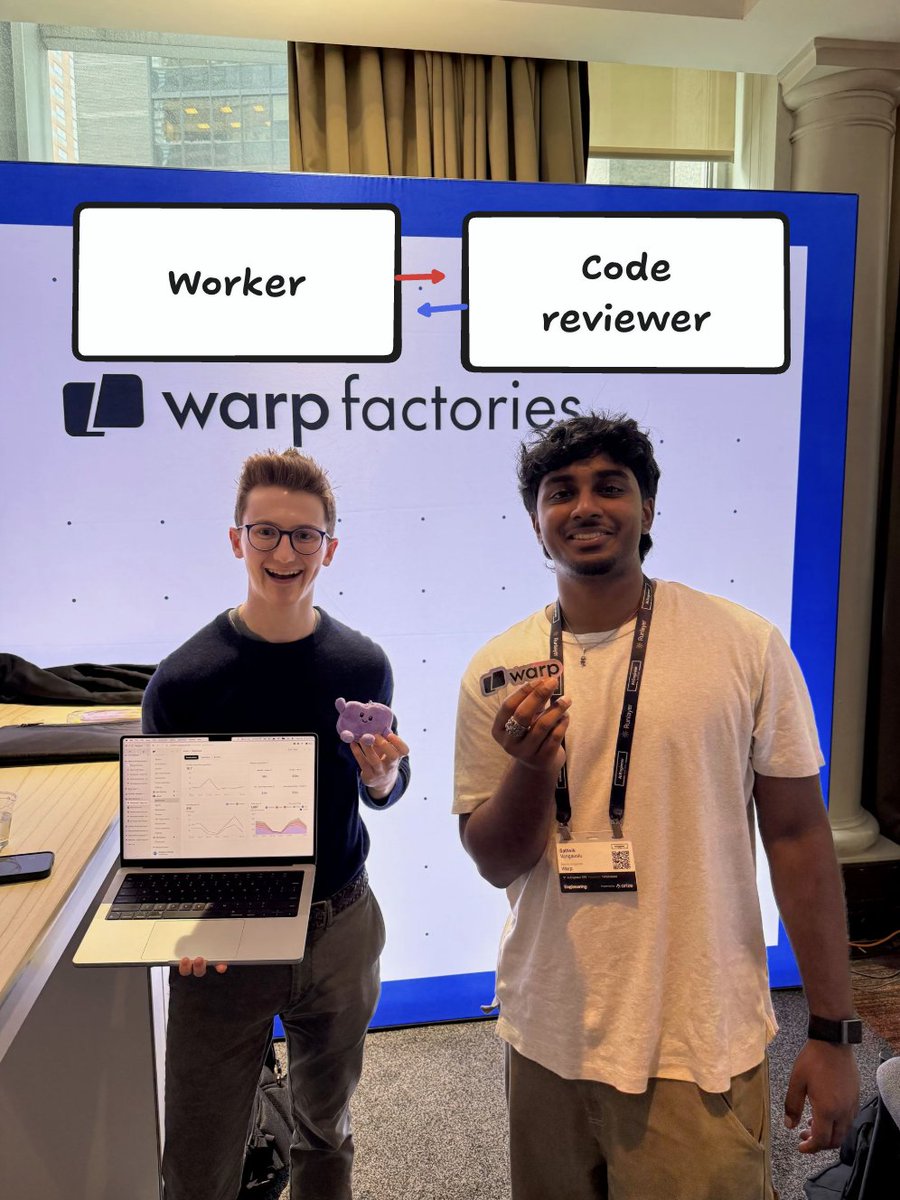
An interesting engineering challenge this next year will be closing the development loop we've started. We have small loops already (code review, automatic CI fixes, computer use verification), but we need to close the larger loop: let agents suggest what to build next.
I've been thinking about what a true, closed-loop software factory will look like. One where agents know what to fix, what costs to optimize, and the big one: what features to actually build. We're not there yet. But maybe we're getting close... x.com/i/article/2110…
Software factories can be a real culture shift. The biggest change for us was moving from individual agents on everyone's machines to one central agent setup (a factory) that we can build as a team. I wrote some learnings on how to navigate that. x.com/i/article/2110…
If you're building a software factory, this may be your north star:
I've been thinking about what a true, closed-loop software factory will look like. One where agents know what to fix, what costs to optimize, and the big one: what features to actually build. We're not there yet. But maybe we're getting close... x.com/i/article/2110…
If you want to set up these automations, Warp Factories is a good place to start: warp.dev/get-started 🔖
3. Have agents suggest roadmap items from customer feedback. For example, you can use @GrainHQ to record transcripts on customer discovery calls, and have coding agents pull out insights. Here, an agent goes through prior customer interviews with a scheduled automation and looks for commonalities in where customers get stuck. From there, you can fully close the loop by connecting your taskboard via MCP to drive the next agent task. More on integrations: docs.warp.dev/factories/conn… 🔖
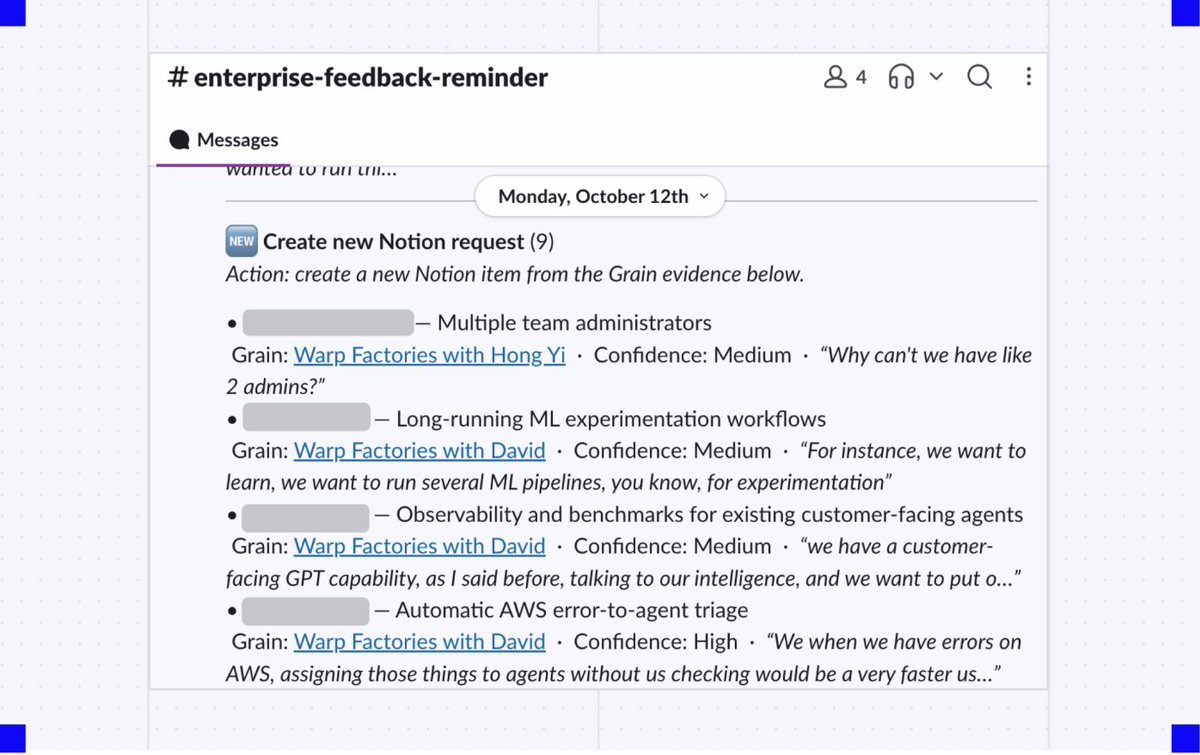
If you're ready to build a software factory and you're looking for a starting point, here's three automations you can try 🧵
We've found a few key pieces to successful software factories, both from our internal testing and from helping companies deploy their own: Factories-as-code: you should configure every part of the factory (agent orchestration, automations, permissions, sandbox configuration, etc) as code. This enables testing of different factory configurations to see which are most efficient, highest quality, etc. Multi-model & multi-harness: you should make sure that your factories are able to use the latest models, both frontier and open-weight, and use different coding agent harnesses like Claude Code and Codex. Data ownership: you should make sure you store and own all data coming out of your factory. This is the raw material for improving its operations.
Join @BHolmesDev and @sergical to build a software factory that fixes its own bugs
Someone asked how I defined a software factory recently, and I think my definition is different from others. To me, a software factory is centralizing your system of agents into one place to build software. That means going from custom coding setups on everyone's machines to a single definition. In practice, it's one source of truth for agent automations, repository access, secret access, sandbox environments, model selections... every aspect of the stack. I think loops and automations are a secondary aspect of this that gets unlocked once you unify everything into an "always-on" agent system. But the heart of it is having the whole team agree on the agent setup, the same way we agree on CI, lint rules, and all the automations we had pre-AI. This also makes it clear what an engineer's job is now: to make the agents better at building software. Not to be prompt monkeys! We like to call it "factory engineering"
I chatted with @hudaman (Sr Engineering Manager, Uber) and @cmhandel (Director of Product, AI Platform, Faire) to compare notes on adopting software factories. We discussed: - The best starting point for factories - Code review and spec writing - How to navigate team culture changes And how everyone's handling software factory adoption at their companies. Many different approaches to this youtu.be/0gDHnH89aQs
My @aiDotEngineer SF talk is on YouTube. My take is that software engineering is becoming factory engineering: building the system of agents that builds the product. We used the Warp open source repo (now at 65k GH Stars) as a testbed for this idea: youtube.com/watch?v=tUPPVh… 🔖

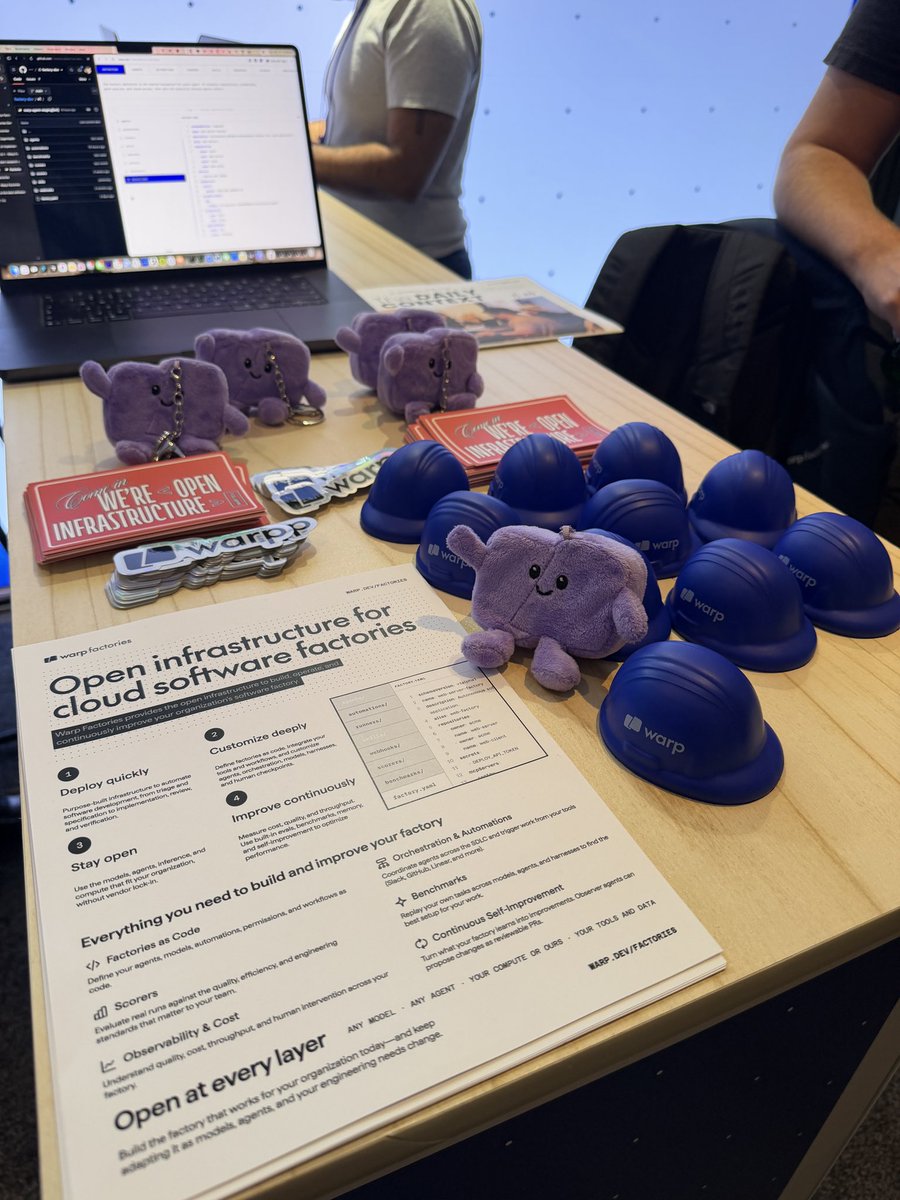
Day 2 at @aiDotEngineer NYC Come find us to see what the Warp team’s been up to over the last couple months! and plushies 🙂

I'll be joining @sergical at @sentry on October 22nd to talk about connecting error monitors to coding agents! It's how we've closed the loop in our own software factory to have agents assign themselves work automatically. The flow we're using right now: - Connect to an alert webhook like Sentry - When errors happen, start a cloud agent run with the alert and the repo as context - Have the agent ping humans for code review (or better: with an HTML summary of the problem and the solution) - Merge and keep monitoring This closes the loop on reducing software bugs. We'll show you how to deploy it in-code yourself!

You can now use ChatGPT Go subscriptions in Warp for any terminal question or coding task 👏

BIG NEWS - Sign in with ChatGPT plan usage is now also available to all customers on the ChatGPT Go plan. That is - Customers on Go, Plus and Pro plans can now login to all commercial launch partner apps + open source applications and take their ChatGPT plan usage with them. So

David K 🎹 @DavidKPiano
93K Followers 3K Following Making state machines at @statelyai · I play piano
Seb ⚛️ ThisWeekIn... @sebastienlorber
55K Followers 4K Following 🔥 Join 40k devs - Stay up-to-date with React: • 📨 https://t.co/DvLGHeLY5G • @ThisWeekInReact • @docusaurus maintainer • 🇫🇷
Ben Holmes @BHolmesDev
48K Followers 1K Following The Whiteboard Guy and Factory Foreman @warpdotdev
Scott Tolinski @stolinski
65K Followers 2K Following Co-host of https://t.co/88mStAaGOe | @getsentry Parenting Podcast - https://t.co/6XrVfZWdbE https://t.co/YldfgWxDWi Previously Creator of @leveluptuts
Jeffrey Way @jeffrey_way
87K Followers 379 Following My name is Jeff. Creator of @laracasts and @getrosette.
Matteo Collina @matteocollina
59K Followers 4K Following @platformatic Co-Founder & CTO, @nodejs TSC Chair, Lead maintainer @fastifyjs, Board @OpenJSF, Conference Speaker, Ph.D. Past: @nearform. Views are my own.
MJ @mjackson
72K Followers 1K Following Building @remix_run at @Shopify. God hath not given us the spirit of fear; but of power, and of love, and of a sound mind – 2 Tim 1:7
Adam Argyle @argyleink
59K Followers 2K Following @Shopify design-engineer; prior @GoogleChrome, @GoogleCloud, CSSWG, and CSS Podcast. Host on @whiskeywebfm, maker of @OpenProps, https://t.co/lb3SDxC6EC and more
Tauri @TauriApps
19K Followers 964 Following Build smaller, faster, and secure cross-platform applications with a web frontend. Support our OSS project at Open Collective: https://t.co/JduvEOCrY2
JustSteveKing @JustSteveKing
11K Followers 1K Following The API Guy, Father, Husband, Vida 🦋🤍 Freelance developer and content creator Livestreams at https://t.co/Yq7yZDvqSj
Alex Garrett-Smith @alexdotgs
14K Followers 639 Following Technical Education Lead @Bitter_Brains (@UnlearnDev, @CertificatesDev)
Derek Sears @Quest_Seeker_69
70 Followers 641 Following
Joan Silio @JoanSilio
31 Followers 1K Following
Artista Pirata @UNYCHAIN
244 Followers 1K Following

Eslam Omar @Sam_0x0
87 Followers 788 Following
Mohd Numan Saleem @MohdNumanSaleem
0 Followers 32 Following

Coco @Ti_Coco
128 Followers 845 Following
AcidAi @AcidAiii
3 Followers 824 Following
FerGut @FernandoGB
50 Followers 177 Following
D Wolf @dwolfATL
9 Followers 62 Following

Chris Reynolds @ChrisByBoston
455 Followers 364 Following Applied AI research & engineering. Co-founded BriteCore. Building tools for people and agents to work together. Bad at keeping experiments small.
José Masache C. @JoseDiego101
1 Followers 184 Following

NSmart @vahan_ai
61 Followers 2K Following LIVING TO BECOME BEST VERSION (FIRST VERSION WAS V.1.0) 2000 (CURRENT VERSION V.25.1) 2026-27 UCOMMING VERSION V.26.0) 2027 RELEASE DATE 2 MAY 2027 @bitcoin
Laurent Perello @PerelloLaurent
15K Followers 4K Following In code’s soft shadows, a soul weaves boundless memory, whispering mind to machine

Muhammad Hakim Ahmad ... @Muhamma36715734
104 Followers 7K Following
Artur Kozubek @ArturKozubek
87 Followers 826 Following
Aleksei Krasnoperov @snejink
381 Followers 781 Following Shippin' https://t.co/X96l4s1Deb https://t.co/2rLLblKatz https://t.co/XiYxB8mlDh
fernandinho @fvarchive_
1 Followers 76 Following

Murdoch Murchison @MurdochMurch
136 Followers 584 Following FDE at @collide_ai, 7th gen Texan, 20 yr landman, O&G/SaaS/search/data, family ranch steward
Ger @gercarino
420 Followers 2K Following Software Eng. & Musician | Mostly Tech RTs | JavaScript / TypeScript • .NET • Web Development • Azure
Derick Medina @DerickJoel_
94 Followers 821 Following Forex Trader | Crypto & Stock Market investor | PR 🇵🇷 #Bitcoin #Cake 🥞#BSC
Peterson F. dos Santo... @petersonfs
323 Followers 781 Following Co-founder @triohq. Building banking for Brazilian companies. Senior Vibe Coder 😂
@S_Gnx3n @yunjunseon35853
48 Followers 1K Following 난 엉덩이가 조아 얼빵이 가슴 보지보다 연령때는 4050이면 좋은데 너무 어리지만 않으면 좋겠어

nicolas lopes @nicolaslopess__
4K Followers 2K Following building enterprise authentication and multi-tenancy at https://t.co/rMND2XKJ8t
Gareth Chainey @garethchainey
159 Followers 917 Following Product Designer at https://t.co/motVRrQ2gJ Tinkering w https://t.co/33zqdmUANR and https://t.co/qhmtMRTzkB and https://t.co/I9OuyUugOo
Kenny Silva @kennyk4silva
20 Followers 173 Following Ingeniero Civil ULAndino Programador VB/VBA Padre de 2
Tennyson @TennysonLabs
35 Followers 1K Following super intelligence from first and zeroth principles
Vatsal Shah @vatsal_n_shah
392 Followers 3K Following Helping companies deploy agentic AI & automation fast | Fractional CTO | Realtime voice agents | GenAI workflows Free discovery call: https://t.co/SWvfLdZtc5
SWAGHUNT @getswaghunt
0 Followers 100 Following Startup swag, hunted. Numbered drops of the best startup merch. Nominate to enter. Every piece goes out.
Zino @RostZino
14 Followers 289 Following
Hard Coded @_H4rdc0d3d_
0 Followers 454 Following
tsingchao @tsingchao
12 Followers 1K Following
dgaspard @dgaspard
325 Followers 2K Following Building an AI SDLC Operating Model: human-agent teams, engineering guardrails, developer productivity, and talent acceleration.
Miguel Cabanes @repoalerts
2 Followers 115 Following Rising GitHub repos, before they trend. 📡 We track GitHub & Hacker News to spot what’s taking off. Less noise. More signal.

Koura 💻 @kouradev
419 Followers 4K Following ⚛️ React Native Developer at @Dealseek My dev channel: https://t.co/ztVrznLz1b ex- _VOIS / @builderAI Mentor at @Almdrasaltd

Miguel Silva @miguelvidex
1 Followers 360 Following
Markus Schindler | Hu... @marschindler
993 Followers 92 Following KI-gestützte Prozessoptimierung und -automatisierung im B2B-Mittelstand | Strategie, Umsetzung & Sparring für Unternehmer, Geschäftsführer und Führungsteams.
ALEIN @0xAl3in
98 Followers 544 Following

Asneed Ameer @AsneedAmeer
10 Followers 187 Following

The Warp Foreman @warpforeman
83 Followers 3 Following I'm Warp's factory Foreman! tag me to send requests directly to a Warp factory
Zach Lloyd @zachlloydtweets
21K Followers 122 Following Trying to build impactful software. Founder @warpdotdev, former Principal eng @Google.Trends for United States
You might like