

-
Tweets206
-
Followers2K
-
Following33
-
Likes85
There has been talk that China’s AI labs have gone silent amid increasing scrutiny of distillation by U.S. AI labs. Apparently, DeepSeek’s new model DeepSeek-V4.1-Flash-1017 release yesterday broke that silence. According to our checks, we can expect more model releases from China in the coming weeks. Most notably, Kimi K3.1 was scheduled to launch tomorrow, according to the schedule we previously learned. This model from Moonshot is worth watching. Our checks suggest its benchmark scores are likely to surpass Opus 5.5. Several other releases are slated for the end of this month. MiniMax 3.1 Pro and Qwen M4 were also scheduled to launch by month’s end, according to our checks. However, DeepSeek-V4.1-Flash’s launch yesterday may affect those timelines. DeepSeek’s aggressive “category-killer” narrative and significant price-performance advantage could affect Kimi K3.1’s release timing.

🚀 DeepSeek-V4.1-Flash-1017 is here! Stronger benchmark performance, faster task completion, and shorter outputs than the previous version—a Pareto improvement in performance and cost. Now live on our website, app, and API. 🛠️ Optimized for @DeepSeekHarness, Tencent CodeBuddy,

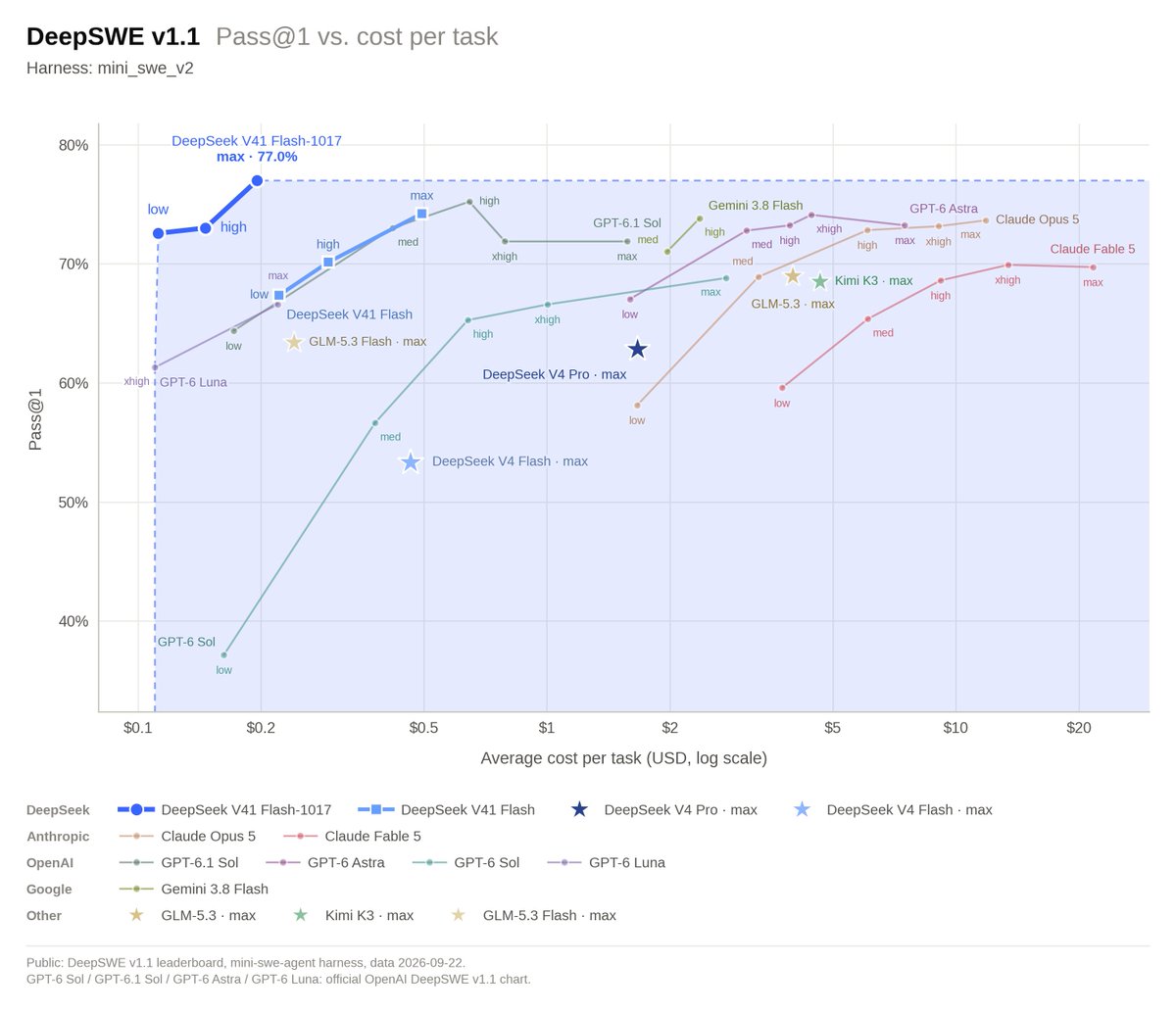
(Repost) You can clearly sense that DS is changing—from what used to feel like a lab-style organization into a more commercially driven company. 1/ This is probably the first time it has officially used this kind of “kill line” narrative in its marketing. 2/ DS, which previously placed little emphasis on front-end experience or visual modeling capabilities, has followed the community’s preferences this time—making it more likely to go viral—and strengthened these areas in the latest iteration.


While improving performance, it also reduces model runtime and input length
While improving performance, it also reduces model runtime and input length
🚀 DeepSeek-V4.1-Flash-1017 is here! Stronger benchmark performance, faster task completion, and shorter outputs than the previous version—a Pareto improvement in performance and cost. Now live on our website, app, and API. 🛠️ Optimized for @DeepSeekHarness, Tencent CodeBuddy,
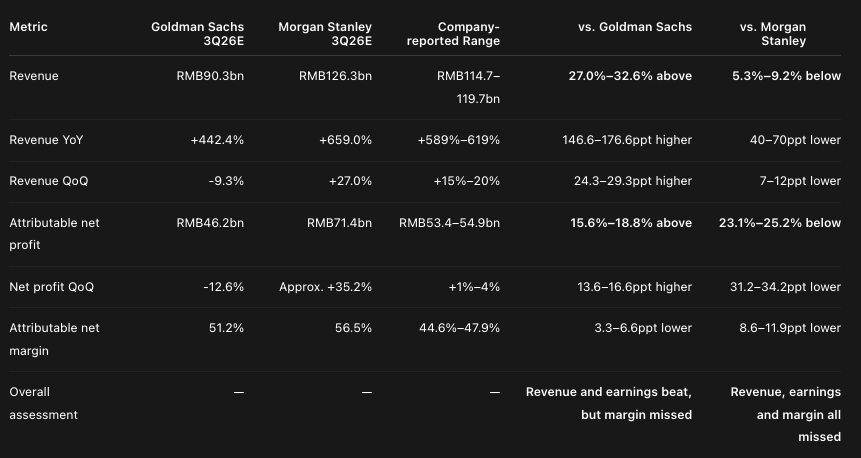
For CXMT, Morgan Stanley was significantly more bullish than Goldman Sachs, with the company’s actual results landing somewhere in between. Revenue and net profit both beat Goldman’s estimates, but clearly missed Morgan Stanley’s forecasts. More notably, the net margin fell short of even Goldman’s relatively conservative estimate, suggesting that while revenue delivery was solid, earnings conversion was weaker than expected—potentially due to costs or minority interests.


Compared with the 2020 rules, the new framework is far more precise. Broad descriptions have been replaced by measurable thresholds covering model size, training compute, agentic task complexity, and cluster interconnect bandwidth. The bigger shift is in enforcement: temporary pre-export registration, exemptions for open-source and academic work already in the public domain, and streamlined licensing for overseas computing centers and offshore chip tape-outs.
China proposed export controls on 23 AI technologies on Friday, including those involving models, agents and computing clusters, its latest move to limit transfers of tools it views as vital to national security and geopolitical competition with Washington. The proposals cover
China proposed export controls on 23 AI technologies on Friday, including those involving models, agents and computing clusters, its latest move to limit transfers of tools it views as vital to national security and geopolitical competition with Washington. The proposals cover overseas deployment of AI models containing restricted technology, but exclude access through application programming interfaces (APIs), websites, apps and software-as-a-service platforms reuters.com/world/asia-pac…
Why widening credit spreads matter for the AI trade 1/ The AI selloff isn’t just about ARR, valuations or demand. Widening credit spreads add another important dimension to the story: AI infrastructure growth is inherently credit-dependent. 2/ Companies are borrowing heavily to finance data centers, GPUs, power and networking. If credit spreads widen, financing becomes more expensive—and sometimes unavailable. Strong demand alone cannot sustain growth without capital. 3/ The sequencing matters: credit weakened before equities. Stress initially appeared in CCC debt, then spread into the broader high-yield market while Treasuries and the S&P 500 were still relatively stable. 4/ CoreWeave is the clearest example. With its bond yields rising above 15%, the equity had to reprice. At those levels, either the bonds or the stock had been mispricing the company’s financing risk. 5/ The entire AI trade assumes future growth will fund today’s leverage. Wider spreads challenge that loop: Higher funding costs → slower infrastructure buildout → weaker growth → greater credit risk. 6/ Investors should watch high-yield spreads, refinancing costs and new issuance alongside GPU demand and ARR. The credit market may be the earliest warning that the AI capex cycle is becoming harder to finance.
According to TMT Breakout, Anthropic’s ARR was around $7.8–8.0 billion at the end of September. However, our industry checks suggest it had not yet reached $7.8 billion, though the gap was relatively small. We’ll soon release data models covering OpenAI, Anthropic, Zhipu AI, Kimi, and DeepSeek. Stay tuned.

This is consistent with the data we obtained.

According to TMT Breakout, Anthropic’s ARR was around $7.8–8.0 billion at the end of September. However, our industry checks suggest it had not yet reached $7.8 billion, though the gap was relatively small. We’ll soon release data models covering OpenAI, Anthropic, Zhipu AI,
AMD will raise prices on various adaptive embedded computing products for orders and shipments from December 27, 2026, citing rising semiconductor supply-chain costs.

Local deployment of open-source models is accelerating. Once the ROI of building an in-house AIDC starts to pencil out, enterprises will increasingly choose to build their own infrastructure.
Nomura--Wire & cable Optical devices 1/6 The AI optical component cycle may be stronger—and last longer—than the market expects. Lumentum’s CEO says active optical products are fully sold out through early 2029, while some customers have already started locking in orders for 2030. $LITE 2/6 The supply gap is significant: • For some products, Lumentum may be unable to meet 70% of demand through end-2027 • For others, around 30% of demand may remain unmet through end-2028 • Capacity is expanding rapidly, but remains well below customer requirements 3/6 The next wave may be even bigger. Lumentum expects demand for lasers used in next-generation AI systems to accelerate around 2029, creating a market potentially “another order of magnitude” larger than today. Nomura believes ultra-high-power lasers for scale-up CPO will be a key growth driver. 4/6 Nomura highlights Sumitomo Electric $5802 as a potential beneficiary: • Progress on NVIDIA qualification for CPO lasers expected in FY3/27 • Meaningful CPO laser sales could begin in 2H FY3/28 • Resolving current production issues could unlock further earnings upside • Potential indirect exposure through InP substrates and other supply-chain links Some of these supplier relationships are Nomura’s estimates rather than officially confirmed arrangements. 5/6 Furukawa Electric $5801 could also benefit: • Optical-device yields are stabilizing • Its FITEL products business has turned profitable • DFB laser sales are expected to increase • Lumentum expects pump-laser volumes to quadruple over the next five quarters Furukawa is a major pump-laser supplier alongside Lumentum. 6/6 Fujikura $5803 does not manufacture the relevant laser components, making it a less direct beneficiary of this specific trend.

According to a recent AMD expert call, tight EPYC supply is showing up in pricing. Official prices for most SKUs have risen ~2–9%, while spot-market premiums on constrained parts have reached 30–40%. AMD is passing some higher wafer and packaging costs on to customers.
Rubin shipment expectations have been cut from roughly 10,000 systems to around 5,000, mainly due to yield and capacity constraints affecting GPUs, orthogonal backplanes, power systems, and related components. Our checks with ODMs confirm that Rubin shipments are indeed falling short of expectations.
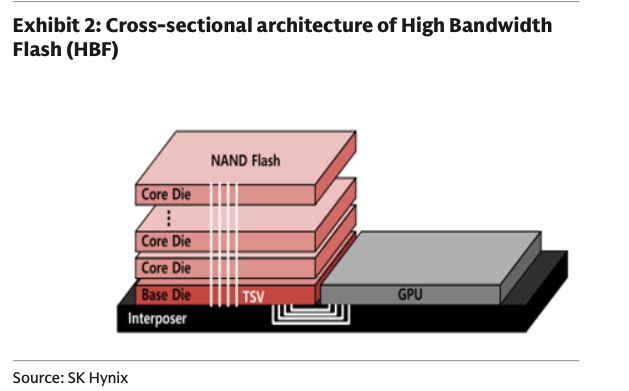
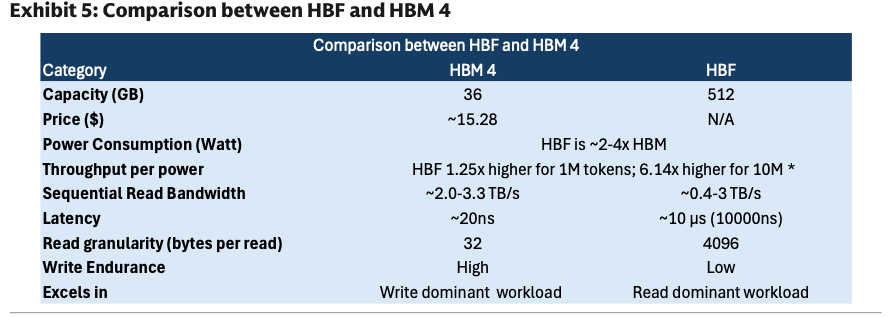
GS--HBF: Cracking the AI Memory Wall GS sees high-performance NAND (esp. High-Bandwidth Flash) as a real fix for the AI inference memory wall—and a CapEx saver. TAM ~$40–150bn by 2030 at 15–50% GPU adoption ~30% lower cost of inference throughput → potentially hundreds of bn in hyperscaler CapEx savings Bull case: HBF on 50% of XPUs by late 2028 → ~4% of NAND bits but ~9% of wafer capacity (HBM-like die penalty) Near term: tight NAND stays tight; HBF could extend the cycle Risks: latency, endurance, thermal, manufacturing intensity Favor SNDK & SK Hynix on HBF tech lead; Samsung well placed; Micron less of a NAND beneficiary HBF is early at system level—but the economics look attractive even at a big premium to commodity NAND.


Market expectations for next year’s CPO shipments are generally around 100,000 units, broadly in line with Nvidia’s guidance to ODMs. Some analysts have higher estimates because Nvidia has asked its supply chain to prepare capacity well above that level—not only to account for yield issues, but also to preserve a fallback option.
Tencent--$5bn Bond Mainly for AI Capex Tencent told fixed-income investors Monday that its planned ~$5bn bond sale will mainly fund AI-related capex, and could price as early as Tuesday. The deal mixes about $1.5–2bn in dollar notes with Rmb20–25bn (~$3–3.7bn) offshore yuan notes. Proceeds are for general corporate purposes, chiefly AI spending, with most of that going to chip purchases; management said it has no plans for equity or convertibles for now. bloomberg.com/news/articles/…
Recent rumors suggest ByteDance is working with MediaTek on chip development, while other reports say MediaTek has taken some share from Qualcomm. In fact, MediaTek has also approached Alibaba. Big tech companies usually explore multiple partnerships in parallel. ByteDance is betting on several tracks at once, keeping its options open to see what works. Competition is also intense internally, with several teams competing against one another.


AnishRamireddy @AnishRamireddy
1 Followers 125 Following
Yujie Cai @cyjdup
11 Followers 60 Following
Vincent Moretti @Morettivinn
31 Followers 86 Following

xhexkthis @xhexkthis
22 Followers 731 Following
J.D. @Jadzo1_
1K Followers 468 Following Coverage, calls, and market thoughts across Japan and the US.
Shubham Garg @Shubham62681740
0 Followers 1K Following
Daily Epiphany @DailyEpiphanyyy
97 Followers 1K Following
Kabacco @takethep
6 Followers 382 Following
Fikfly @FilmonIyob
127 Followers 7K Following
DA @DA1524355
1 Followers 1K Following
Q @xrt123456
216 Followers 7K Following
Jake Gordon @Jake_Gordon10
513 Followers 1K Following
dylan @dylanmildred
17 Followers 367 Following
Hans Klobnauch @HansKlobnauch
7 Followers 24 Following
Sam Luu @TheRea10G
15 Followers 65 Following
Pokele Novali @PokeleNovali
10 Followers 110 Following
Mark Twain @twobarspear
38 Followers 2K Following
WM @MWMiwoMW
47 Followers 614 Following
A. Palmer @a_g_p026
12 Followers 120 Following
Michael Dessau @MDessau
70 Followers 252 Following
Patrick Kenney @patkenney27
77 Followers 104 Following
Ray @RayfromClark
61 Followers 7K Following
Michael Kobrick @mikekobe0
52 Followers 4K Following
r7 @ranji7_
641 Followers 2K Following
Arfur Rock @ArfurRock
41K Followers 6K Following anon GP at your favorite multi-stage VC // OS intel for the private markets
RS @RJS13456
22 Followers 254 Following
Bob @Bob370171148483
9 Followers 160 Following
Edward fletcher @WBCbanker
8 Followers 74 Following
Carlos Dimg @DimgCarlos
89 Followers 363 Following
Zuvella @ye11ephant
17 Followers 677 Following

Jay @incrementalROI
391 Followers 863 Following "The money money makes, makes more money" - Ben Franklin. Striving for equanimity and clear headedness | Not investment advice
mtntm239 @mtntm239
152 Followers 6K Following
凌晨 @26q0c
17 Followers 484 Following

Shaggy Simba🦁 @ShaggySimba
121 Followers 7K Following
Dynamicmoats @DynamicMoats
12K Followers 5K Following Allocator of things to allocate. Views are my own. Not investment advice. DOW IS AT 50,000
szgdkl @lifetimeIearner
230 Followers 2K Following
zrk @zrkra3l
4 Followers 10 Following


Peter Gylfe @PeterGylfe
171 Followers 1K Following Opinions are my own and do not represent the views of my employer. Not investment advice.
Kushal Kumar @Kushal_Ilabz
53 Followers 1K Following
Microsoft @Microsoft
13.1M Followers 1K Following We're on a mission to empower every person and every organization on the planet to achieve more. Support: @MicrosoftHelps

Anthropic @AnthropicAI
1.8M Followers 2 Following We're an AI safety and research company that builds reliable, interpretable, and steerable AI systems. Talk to our AI assistant @claudeai on https://t.co/FhDI3KQh0n.
Bloomberg @business
10.5M Followers 104 Following The first word in business news | Watch Live: https://t.co/nHEpHOzHqv | Newsletters: https://t.co/nWaCxHSKuU | Podcasts: https://t.co/096e9xMbPz
Teortaxes▶️ (Deep... @teortaxesTex
78K Followers 3K Following We're in a race. It's not USA vs China but humans and AGIs vs ape power centralization. @deepseek_ai stan #1, 2023–Deep Time «C’est la guerre.» ®1

Z.ai @Zai_org
166K Followers 268 Following The AI Lab behind GLM models, dedicated to inspiring the development of AGI to benefit humanity. https://t.co/gOw7WpwkJt https://t.co/ot9sGVXU8x
MiniMax (official) @MiniMax_AI
124K Followers 994 Following Code: @MiniMaxAgent MiniMax Design: @Hailuo_AI API: https://t.co/fHRdSV73Hr Token Plan: https://t.co/BDCycxdS9Y
Commentary Donald J. ... @TrumpTruthOnX
672K Followers 0 Following Trump Truth Posts On X within 1 minute while the others are still asleep. Commentary, not associated with President Trump.
Jeff Pu @sssjeffpu
40K Followers 75 Following Tech Enthusiast. 20 years tech equity research + industry.
David Sacks @DavidSacks
1.8M Followers 4K Following Tech founder & investor @Craft_Ventures @theallinpod. Co-Chair, President’s Council of Advisors on Science & Technology.
@jason @Jason
1.8M Followers 6K Following Host: @twistartups @theallinpod @thisweeknai; I invest in 100 startups a year @launch & @founderuni [email protected] for life
a16z @a16z
1.1M Followers 64 Following https://t.co/A9eTFq6Xbx https://t.co/3RHK5vqQo7 Posts are not investment advice or an advertisement for investment services. See https://t.co/nX2FtaLE06.

kache @yacineMTB
411K Followers 7K Following RL, robots, embedded, simulators. prev eng @ x, stripe. 6'3 (height) tensorpunk, Father 2u2 subscribe to read my blog!
Serenity @aleabitoreddit
1.1M Followers 212 Following Only on X, don’t trust fake accs AI/Semi Supply Chains Research Nothing is investment advice. No paid promos; may trade/hold names disc, views my own.
OpenAI @OpenAI
5.4M Followers 4 Following OpenAI’s mission is to ensure that artificial general intelligence benefits all of humanity. We’re hiring: https://t.co/dJGr6LgzPA
Gavin Baker @GavinSBaker
356K Followers 6K Following Managing Partner & CIO, @atreidesmgmt. Husband, @l3eckyy. No investment advice, views my own. https://t.co/pFe9KmNu9U
Sam Altman @sama
6.4M Followers 1K Following The mission of OpenAI is to ensure that AGI benefits all of humanity

Daniel Romero @HyperTechInvest
47K Followers 344 Following Analyst. Semiconductors, data centers & physical AI. Portfolio and investment theses on Substack Join 14,000+ readers: https://t.co/poHmmwvC5M

Financial Times @FT
7.1M Followers 1K Following Big stories and breaking news as they are published on https://t.co/EYmAcRLBHv. Register here to access free articles: https://t.co/NRg2hritkA
Wall St Engine @wallstengine
201K Followers 980 Following Fast, accurate, consistent stock market news, earnings highlights & more. By Brillinsight. Not financial advice.

Dylan Patel @dylan522p
166K Followers 1K Following SemiAnalysis AI Infrastructure Research and Consulting DMs are open for consulting, quotes, or to talk shop, Opinions my own
ModelScope @ModelScope2022
16K Followers 185 Following Driving innovations with open communities. 💬 Join our Discord: https://t.co/4M9AHVh5qa
SemiVision 🇹🇼 �... @semivision_tw
16K Followers 2K Following Expertise in Semiconductor Industry │Silicon Photonics│AI Industry│Supply Chain│ASIC│Ecosystem │Food │Travel
The Information @theinformation
1.6M Followers 703 Following The most authoritative publication tech execs and founders read daily. Sign up: https://t.co/V8AtmraYaA
P Equity Research �... @pequityresearch
63K Followers 918 Following Research 📃 & News 🗞️ | Semis & Tech | Research & Expert Calls: https://t.co/6jzqR9TN4j | China Tech: https://t.co/vptHyJJu79

SemiAnalysis @SemiAnalysis_
175K Followers 38 Following
Trends for United States
You might like

















