

Goodfire @GoodfireAI
Using interpretability to understand, design, and align AI. goodfire.com San Francisco Joined August 2024-
Tweets900
-
Followers28K
-
Following45
-
Likes2K
interpretability might be the most important scientific problem in the world right now, as I don't think we can solve alignment if we don't know what we're building. I think I have good news about it. I co-authored early work in mechanistic interpretability at OpenAI and came away pessimistic, because neural networks appeared to fold into arbitrary tangled knots. years later, I started openai's first large-scale automated interpretability project, finding about 2% of neurons legible with the primitive tools we had with modern agentic tools and a much closer look, the picture looks totally different. the vast majority in models up to trillions of parameters are legible, and their circuits beautiful. many famous examples of tangled neurons turned out to be misunderstood. The roadblocks I expected mostly aren't there. I now think ambitious interpretability will be solved by the time we need it most, and possibly quite soon, as automated scientists keep improving. it may be a bitter lesson for interpretability: the simple thing, at absurd scale, works already-clean.goodfire.com
We identified a gene variant behind hearing loss, a big step for interpretability in medicine. In April, our interpretability system EVEE scored all 4.2M variants in ClinVar, the NIH's variant database. MEPE c.209_212del scored particularly high, so we built a case and had it successfully reclassified as "likely pathogenic." ~2M variants are still "uncertain," but we believe interpretability can help us understand many more!
The variant: ncbi.nlm.nih.gov/clinvar/variat… How we made EVEE: goodfire.com/research/evee-…

AI can explain its reasoning. That doesn’t mean we know how it made the decision. @GoodfireAI co-founder and chief scientist @banburismus_ joins Rocket Drew to explore what AI “brain scans” could reveal that written reasoning misses. 🚀 Watch AI Deep Dive on YouTube: thein.fo/3VJTpzl Spotify: thein.fo/4e6QSp8
🚀 AI Deep Dive Episode 5: Can We See Inside an AI’s Mind? AI can write down its reasoning. But what happens when more of its thinking never makes it onto the page? @rocketalignment and @GoodfireAI co-founder and chief scientist Tom McGrath explore what AI “brain scans” can reveal beyond written reasoning, how internal signals could help catch cheating, and what it would take to understand—and change—what models learn. 00:00 Intro 00:39 Tom McGrath and AI brain scans 09:01 Written reasoning and hidden computation 17:45 Why AI is hard to understand 24:07 How researchers identify concepts 31:10 What interpretability could change 34:42 Reverse engineering a language model 43:09 The field’s approaches and investment 51:51 Changing models without hiding problems 1:00:10 AI agents studying AI
Teams can configure how their applications respond when a concern is flagged, including logging, additional review, refusal, and re-routing. If you serve or train models and want monitors built into your stack, learn more: goodfire.com/blog/goodfire-…
Our activation monitors detect undesired behaviors using signals from inside a model, so they catch more, run faster, and cost less than text-based monitors. Baseten customers can monitor for: - Prompt injection - Actions outside policy - Sensitive data exposure - Cyber misuse
Goodfire safety infrastructure 🤝 @baseten inference Today we're partnering with Baseten to bring real-time safety monitoring to open models. This is an important step toward our vision of ensuring every capable model has a frontier alignment stack.

Open models can come from anywhere. Securing them shouldn’t depend on where you get them. Today we're launching Project Beacon to make safety a default for open intelligence. We're partnering with @GoodfireAI to bring inference and in-line monitoring together for the first
The Alzheimer’s Translation Challenge is led by @PrimaMente and @AlzData, with @nvidia, @huggingface, @nebiusai, Talisman Therapeutics, @UltimaGenomics, @cellanome, @PrimeIntellect, and @boltz_bio. Registration is open now. Competition starts spring 2027: primamente.com/challenges
Participants will use the dataset to build AI models, assessed through a series of evals from general benchmarks to more complex tasks. Top teams will be shortlisted, and their experimental hypotheses tested in Prima Mente's wet lab.
We discovered a new class of Alzheimer’s biomarkers with @PrimaMente. Today we're taking the next step by opening a global AI competition to discover new treatments. Introducing the Alzheimer’s Translation Challenge, led by @PrimaMente and @AlzData. 🧵
Read the full post: goodfire.com/research/produ… If you're interested in deploying these monitors, get in touch: goodfire.com/contact-us
Running the probes during inference maintains the same throughput with no added latency. That’s enabled by our infra engineering, like kernel-level optimizations and a custom inference server.
We built cybersecurity monitors for Kimi K3 and GLM 5.3 — more accurate, 50x faster, & 50x cheaper than an optimized LLM judge. External red-teaming from @farairesearch found that our monitor greatly reduces universal jailbreaks. 🧵
Tue 11am (Franciscan A) Manifold Steering Reveals the Shared Geometry of Neural Network Representation and Behavior Tue 4:30pm (Imperial Ballroom) Do SAEs Capture Concept Manifolds? Wed 4:30pm (Franciscan B) Arithmetic in the Wild: Llama uses Base-10 Addition to Reason About Cyclic Concepts
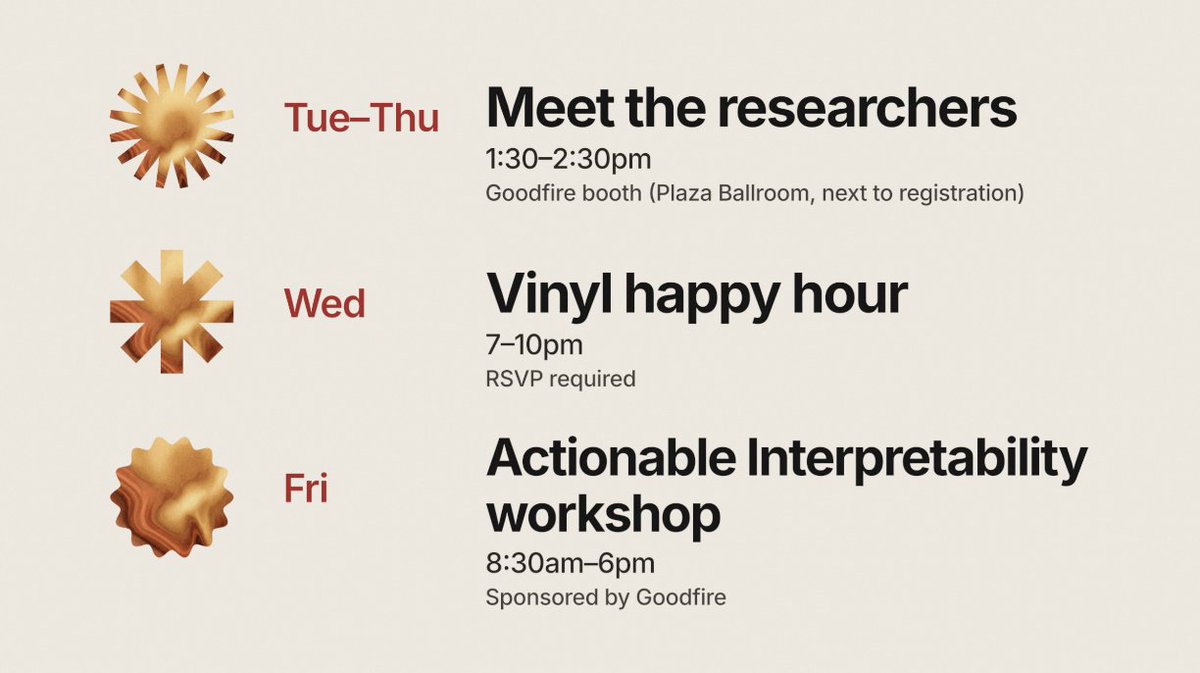
Manifold steering, SAE geometry, and a model that ignores its own clock…our researchers are at @COLM_conf this week to present papers on all three. Meet them at our booth, Tue-Thu, 1:30-2:30pm. Poster times and happy hour RSVP below 👇


Rob Reich @ElencticAI
79 Followers 147 Following Professor @Stanford, @StanfordHAI, former US AI Safety Institute Co-author System Error, author Just Giving

sarahinspaces 🔎 @sarahinspaces
94 Followers 917 Following twirling in the search space / https://t.co/NfNWdqoTzb

Marcus Manley @marcusxmanley
5 Followers 1K Following In peace I will lie down and sleep, for You alone, LORD, make me dwell in safety. + Psalm 4:8/9 + New International Version

Lazar Miovčić @LMiovcic
1 Followers 21 Following

Damien @BlandingoX
0 Followers 89 Following


حمزة محمود @hamzahma31
3 Followers 4K Following
Riley (u/acc) @RileyRostovM
394 Followers 3K Following AI/ML Research Engineer | Spirits of the Computer Conjurer | Simulation Theory Hypercalvinist | Applied Math @uwaterloo | Opinions my own

Mark Kinsey @mwk24
318 Followers 3K Following I learn all I can about creating harmony in oneself and in society. Previously product/eng/design @Facebook.
Tyler Lastovich @tylerlastovich
751 Followers 598 Following Building @ultrametricai (YC P26). Lets reduce assumptions and apply leverage. * AI, episodic memory, inference, trading, and knowledge systems.

Jaffray Woodriff @JaffrayW
7K Followers 5K Following Quantitative Chief Scientist & CEO. Super-early to apply ML to investing. Embrace Simplicity, Beware Complexity. Coding at CODE. Honesty Sleep Squash Hydration.

jas @exp_jas
70 Followers 452 Following

adamspitz.eth @AdamSpitz
147 Followers 317 Following Working in the blockchain world. Father of a toddler and baby twins. Not a fan of wokeness.
Just2 @Just2
11 Followers 96 Following
Apurva Bhatt @apurvakbh
1 Followers 147 Following Trying to be smarter than AI, at AI @walmart (cv, nlp)

streamlined @streamlined19
3 Followers 538 Following
Agi Dubi @AgotaDubi
1K Followers 3K Following Mindware developer. Bodymind explorer. 🎶💃🤸♂️🌊👣somatic awareness, play, non-doing, psychotech • shepherdess of emergence
- @yousef6649
538 Followers 712 Following

khalil sabri @KhaLiloViC_Ss
49 Followers 322 Following
Tom Andersson @tom_r_andersson
2K Followers 427 Following Research Engineer @GoogleDeepMind; Building AI for weather & tropical cyclone forecasting; @WMO Young Scientist of the Year 2022; he/him

Atharv Gupta @Athrv23
0 Followers 16 Following
Chris Iversen @chris_iverzen
189 Followers 956 Following Philosophy may begin with wonder, but it ends in horror

Seth Hain @sethHain
428 Followers 908 Following Contemplations on computation, cognition, chords, and care.... Expressly individual insights
Doug Tarr @doug_tarr
14 Followers 249 Following 🎶 Building for agents and their humans. Prev VPE Search & AI @mongodb, VPE @mlab, cofounder @payscale. Taught thousands of kids to code at MVCode.
corsaren @corsaren
10K Followers 931 Following i like smart people who disagree with me • Kantian rule consequentialist, compulsive centrist, Ratatouille slatist, non-stochastic parrot
Zoomer Alcibiades @HellenicVibes
16K Followers 2K Following You must change your life. Heidegger enjoyer.
Viz @Vizhftj
4 Followers 391 Following
Maya Jabłońska @mj_jablonska
65 Followers 119 Following 🇵🇱🇦🇺 Astronomy PhD student @ourANU | Deputy Lead @universe_tbd | Marketing @MLinPL | she/her
derrick has started y... @dvsch
8K Followers 2K Following Post-AI artist. Product @titlesxyz. Making art at the intersection of Chauncey and Malcolm X.


Conference on Languag... @COLM_conf
8K Followers 7 Following https://t.co/GhGCMEoHU8 Conference: October 7, 2025
Nymph @RhizoNymph
7K Followers 2K Following Exploring the interconnectedness of all things. mech interp systems @GoodfireAI 🏳️⚧️
Satchel Grant @satchelgrant
274 Followers 216 Following

Eric Bigelow @EricBigelow
565 Followers 948 Following AI interpretability + cognitive science @GoodfireAI PhD from @PsychHarvard
Barak @barakwidawsky
240 Followers 490 Following Meat computer seeking to understand the universe @GoodfireAI

Raphael Sarfati @RaphaelSarfati
105 Followers 154 Following interpretability research prev: physics, trails, fireflies
Vasu Shyam @vasud3vshyam
1K Followers 406 Following Currently working as a machine learning researcher at a Silicon Valley startup. Former physics postdoc at Stanford and Branco Weiss fellow.
Tucker Fross @tsfross
45 Followers 65 Following

Thomas Fel @thomas_fel_
3K Followers 1K Following Interpretability, Visual Intelligence @GoodfireAI. Prev: @Harvard, @Google, @BrownUniversity (@tserre lab). Crêpe lover.
Ryo Yamamoto @RyoYbioinfo
358 Followers 522 Following interping bio models @GoodfireAI · behind EVEE prev; PhD UCLA (Zaitlen / Xiao)

Amelia Wattenberger �... @Wattenberger
36K Followers 5K Following design, AI, web dev, data viz, tools for thought ✨ @shv, previously R&D @GitHubNext, design @AdeptAILabs
Silico @silico
65 Followers 1 Following Silico is your interpretability agent - explain, debug, and precisely control model behavior.
Bo Wang @BoWang87
31K Followers 3K Following Prof @UofT | Co-Founder & Chief AI Scientist @Xaira_Thera | Building first Virtual Cell | AI & Bio & Healthcare | Co-Inventor of ScGPT, MedSAM, BIOREASON


Ching Fang @chingfang17
1K Followers 654 Following Member of Technical Staff @GoodfireAI working on AI interpretability for scientific discovery. Prev: @Harvard, neuroscience PhD @Columbia @cu_neurotheory

Ryan Panwar @RyanPanwar
411 Followers 2K Following Understanding artificial minds @GoodfireAI To follow knowledge like a sinking star, Beyond the utmost bound of human thought.
Santiago Aranguri @santiaranguri
832 Followers 134 Following Research Scientist at Goodfire. PhD student (math/ML theory) at NYU on leave.

Aaditya Prasad 🇺�... @_Aaditya_Prasad
1K Followers 857 Following MTS @PrometheusInc | prev @Stanford, @Goodfire
Ekdeep Singh Lubana @EkdeepL
3K Followers 1K Following Member of Technical Staff @GoodfireAI; Previously: Postdoc / PhD at Center for Brain Science, Harvard and University of Michigan
Eric J. Michaud @ericjmichaud_
4K Followers 1K Following Trying to make deep neural networks among the best understood objects in the universe. 💻🤖🧠👽🔭🚀
Curt Tigges @CurtTigges
2K Followers 1K Following reverse-engineering digital cognition at @GoodfireAI | opinions my own

Michael Pearce @_MichaelPearce
328 Followers 645 Following Interpretability @GoodfireAI | Physics | Evolution | Ecology
Lucius Bushnaq ⏹️ @BushnaqLucius
372 Followers 175 Following Ours is the era of inadequate AI alignment theory.
Dan Braun @danbraunai
310 Followers 96 Following big == complex. small == simple. many_small == hopefully simple.
Ren Makino @_renmakino
50 Followers 73 Following

max! @maxsloef
3K Followers 2K Following i care about AI welfare :) prev early at @goodfireai, @websim_ai, @floraai and before that @spc, @uniswap, @snap
dron @_dron_h
721 Followers 474 Following math/music/ai nerd | research @GoodfireAI | prev cambridge, bair, polaris | giving a semantics to the syntax
mark bissell @MarkMBissell
2K Followers 891 Following aspiring gentleman scientist, not necessarily in that order || prev: @GoodfireAI @PalantirTech @UniofOxford @WilliamsCollege
Lee Sharkey @leedsharkey
4K Followers 2K Following Scruting matrices @ Goodfire | Previously: cofounded Apollo Research
Jack Merullo @jack_merullo_
2K Followers 431 Following Interpretability @GoodfireAI was a Phd @BrownUniversity
Arc Institute @arcinstitute
48K Followers 75 Following A full-stack institute for AI and biology research.
Myra @myra_deng
2K Followers 207 Following @meta superintelligence, prev @goodfireai, @twosigma, @stanford
Nick @nickcammarata
113K Followers 911 Following mechanistic interpretability, meditation, jhana brother
Eric Ho @eric_ho
5K Followers 562 Following Co-Founder / CEO @GoodfireAI - AI interpretability research company
Trends for United States
You might like


















